
India’s healthcare system isn’t just under pressure due to a shortage of skilled professionals; it’s also constrained by a communication infrastructure that hasn’t kept pace with rising demand. Phone lines remain overloaded, reminders often go unnoticed, and front-desk teams spend hours on repetitive tasks like appointment confirmations. At the same time, patients trying to connect after hours or during busy moments frequently hit voicemail and disengage, leading to missed opportunities for care.
WhatsApp chatbots are helping bridge this gap. Built on the official WhatsApp Business API and used within an app that over 500 million Indians access daily, they automate key interactions such as appointment scheduling, reminders, FAQs, prescription refills, and follow-ups -24/7, without adding to staff workload. The result is fewer no-shows, reduced call volumes, and a more seamless, responsive patient experience. This guide covers everything you need to evaluate and implement one, from core features and real-world use cases of WhatsApp chatbots to integration, compliance, and rollout.
What Is a WhatsApp Chatbot for Healthcare?
An AI WhatsApp chatbot is a software program that communicates with users through the WhatsApp messaging interface using natural language, making interactions feel conversational rather than transactional. Unlike a website form or a phone IVR, it meets patients in the app they already check dozens of times a day, removing friction and increasing the likelihood of engagement. Instead of navigating menus or waiting in call queues, patients can simply type what they need to book an appointment, reschedule, ask for clinic timings, or check test updates and receive an instant response.
The bot can send and receive text, images, voice notes, documents, and rich interactive messages, all within a familiar green chat window. It operates 24×7, responds in milliseconds, handles thousands of simultaneous conversations, and never puts anyone on hold. Beyond basic interactions, it can be integrated with hospital systems to automate workflows like appointment scheduling, reminders, patient intake, and follow-ups. This not only reduces the load on front-desk staff but also ensures consistency, speed, and accuracy in every interaction, turning WhatsApp into a powerful, always-on patient engagement channel.
Why Hospitals and Clinics Are Using WhatsApp Chatbots in 2026
Healthcare operations are quietly breaking under the pressure.
The problem isn’t a lack of skilled staff or genuine care. It’s that the volume of patient interactions has outgrown the systems designed to handle them. The result? Burnt-out teams, frustrated patients, and a healthcare workflow that creaks under the weight of modern demand.
Healthcare workflow automation and patient communication automation are no longer luxury upgrades; they’re the operational lifeline that keeps clinics running with dignity and operational efficiency intact.
Rising patient volume
India’s outpatient demand is rising rapidly, with millions of new patients entering the system each year. Urban clinics that once handled 70-80 consultations a day are now managing 140-150+, but with the same staff, same phone lines, and the same manual booking processes. The front desk is stretched thin, juggling calls, walk-ins, and scattered messages without a unified system in place. What seems like simple growth is actually a structural mismatch between demand and operational capacity.
Each additional patient adds a small, cumulative burden, more calls to answer, appointments to schedule, and follow-ups to track. Over time, this invisible tax compounds: calls are missed, schedules become unpredictable, staff burn out, and patient experience declines. The issue isn’t a lack of demand, but the inability of outdated workflows to scale with it, turning growth into operational strain.
Staff overload and burnout
A trained nurse spending her afternoon confirming appointment times over the phone isn’t a staffing problem; it’s a systems problem. Across clinics, clinical and administrative staff are buried under repetitive, time-consuming tasks that are, crucially, automatable.
The consequence is real: high turnover, compassion fatigue, errors made under pressure, and good people leaving a profession they love because the operational load has become unbearable. Healthcare workflow automation doesn’t replace these people. It gives them their time back so they can do the work that actually needs a human being in it.
Missed appointments
A no-show is not just an empty chair; it creates a ripple effect across the entire healthcare system. Every missed appointment means lost revenue, underutilised clinical time, and scheduling gaps that are hard to recover. More importantly, it delays care. For patients, a missed visit can mean worsening conditions, prolonged discomfort, or delayed diagnosis. What makes this challenge frustrating is how preventable it is; most no-shows happen simply because patients forget. In busy, unpredictable routines, even important health appointments can slip through without timely reminders.
Automated reminders solve this with simplicity and scale. A message 48 hours before allows patients to reschedule in time, while a second nudge 2 hours before reduces last-minute forgetfulness. The result is a 30-50% drop in no-show rates for many clinics, improving utilisation, patient flow, and revenue without adding staff effort. Beyond efficiency, these systems also generate actionable insights like confirmation trends and patient responsiveness, helping refine scheduling strategies. Delivered through channels patients already use, reminders feel less like alerts and more like helpful prompts quietly strengthening engagement, accountability, and continuity of care.
Support bottlenecks
Unusual or complex queries don’t cause most clinic support bottlenecks. They’re caused by the same ten questions asked by different people, all day, every day. ‘What time do you open?’ ‘Is Dr Mehta available this week?’ ‘How do I get my blood test report?’ Each question takes 2-4 minutes.
Multiply that by 60 queries a day, and your entire morning is gone before the first patient has even been seen. Patient communication automation handles these in under two seconds consistently, correctly, and without a hold tone.
24/ 7 Patient Expectation
Patients don’t feel unwell between 9 AM and 6 PM. A worried parent at midnight, a working professional who only has time to book during lunch, a senior citizen trying to reschedule after-hours, they all reach for their phone, and they all expect an answer.
When that answer is silence or a voicemail, they don’t wait patiently. They call another clinic, search online, or go to the emergency room for something that didn’t need to be. The 24/7 expectation isn’t a patient being unreasonable. Healthcare operational efficiency in 2025 means meeting them where they are.
Top Use Cases of WhatsApp Chatbots in Healthcare
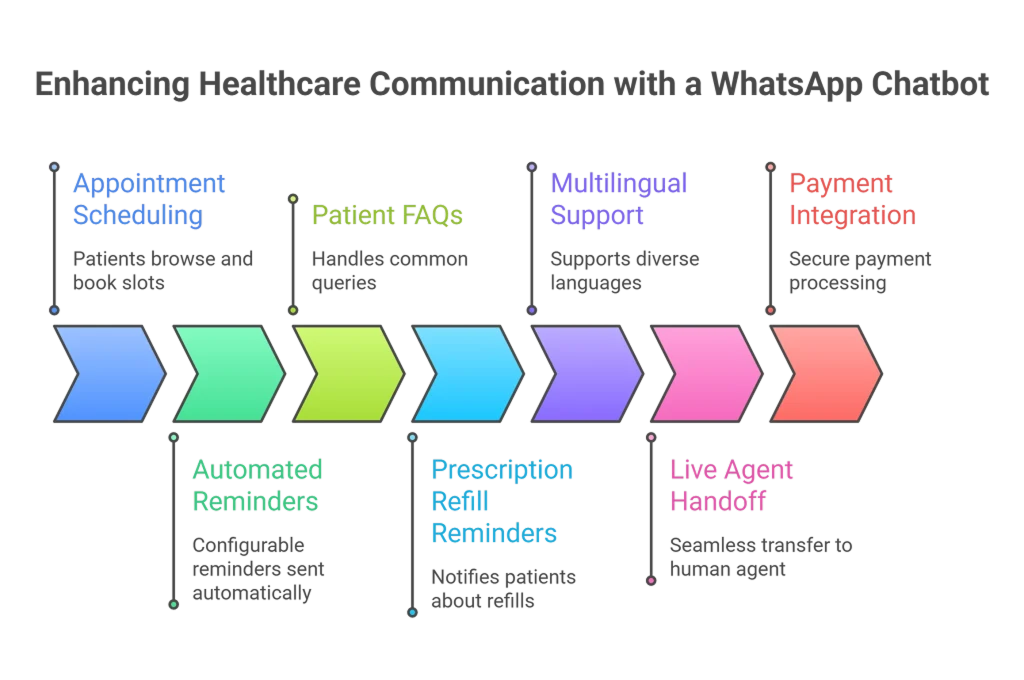
Healthcare today depends on speed and constant communication, where WhatsApp chatbots make a real difference. They automate high-volume interactions, reducing reliance on phone calls and manual processes while keeping patients connected in real time.
WhatsApp chatbots can automate some of the most common patient communication workflows for hospitals and clinics, including appointment booking, reminders, FAQs, follow-ups, prescription refill requests, telemedicine support, and feedback collection. When connected with scheduling systems, CRM workflows, and clear escalation rules, these use cases help reduce front-desk workload, improve patient response times, and create a smoother healthcare experience.
How WhatsApp Chatbots Improve Healthcare Workflow Automation
Workflow automation is where AI WhatsApp conversational chatbots genuinely transform healthcare operations, not just individual tasks, but the end-to-end processes that define patient experience and staff efficiency.
Healthcare Chatbot Workflow Improvements: Before and After Automation Results
| Process | Before ChatBot | After ChatBot |
|---|---|---|
| Appointment Booking | Manual phone calls, staff scheduling, and error-prone | Automated 24/7 booking with real-time calendar sync |
| Reminder Follow-Ups | Staff-dependent calls and SMS batches | Auto-triggered multi-step reminder sequences |
| FAQ Handling | Reception staff answering repetitive calls | Instant AI-powered responses, zero wait time |
| Patient Triage | Slow manual assessment, delayed routing | Automated symptom-based routing and escalation |
| Insurance Verification | Manual back-and-forth with payer portals | Automated real-time eligibility checks |
| Prescription Refills | Patient-initiated calls to pharmacy/clinic | Proactive chatbot-triggered refill workflows |
| Post-Visit Follow-Up | Sporadic nurse calls, low patient response | Structured automated check-in sequences |
Beyond individual workflows, WhatsApp chatbots create a connected patient journey, one where every interaction flows through a single, familiar channel. This continuity reduces patient confusion, improves adherence, and creates richer data for clinical and operational analytics.
WhatsApp Chatbot Integration with Healthcare Systems
Most vendors undersell the complexity of healthcare chatbot deployment. Here are the real challenges you’ll face and how to approach them:
• Compliance Complexity – HIPAA, GDPR, and regional data protection laws impose strict requirements on data handling, patient consent, and breach notification. Navigating these across multiple jurisdictions is time-intensive and requires dedicated legal and compliance resources – not just a checkbox.
• Integration Issues – Legacy EHR and hospital management systems are notorious for limited API support, inconsistent data formats, and siloed architectures. Integration projects frequently run over time and budget. Prioritize vendors with proven connectors to your specific systems.
• AI Misunderstanding Medical Queries – General-purpose NLP models struggle with medical terminology, regional dialects, abbreviations, and the nuanced way patients describe symptoms. Without healthcare-specific training data and rigorous testing, misclassifications can lead to dangerous escalation failures.
• Staff Adoption – Clinical and administrative staff often resist chatbot tools that change their workflows. Successful deployments invest in change management: training sessions, clear handoff protocols, and early involvement of staff in flow design. Technology without people alignment fails.
• Multilingual Challenges – Supporting multiple languages isn’t just translation; it’s cultural context, idiomatic expression, and dialect-specific vocabulary. A Spanish FAQ bot may work perfectly for Mexican patients and fail with Colombian users speaking differently about the same symptoms.
• Scaling Problems – A chatbot handling 500 conversations a day behaves very differently at 50,000. Conversation routing logic, API rate limits, system load during peak hours, and backend database performance all become critical at scale. Plan capacity from day one.
Step-by-Step Guide to Implementing a WhatsApp Chatbot for Healthcare
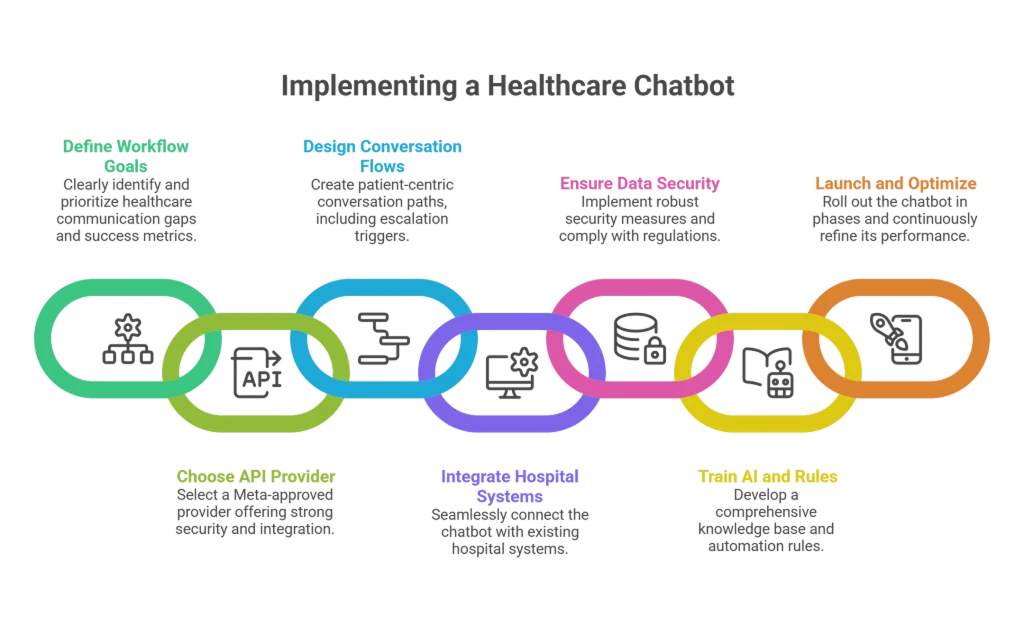
Deploying a healthcare WhatsApp chatbot isn’t just a technical setup; it’s an operational transformation. From reducing front-desk overload to improving patient engagement, success depends on a structured and well-executed rollout. Here’s a complete roadmap from strategy to launch.
Step 1: Define Healthcare Workflow Goals
Begin with a clear audit of your current patient communication gaps. Identify where manual processes are slowing operations, whether it’s missed calls, delayed responses, or frequent appointment no-shows. Focus on three to five high-impact use cases for the initial rollout, such as appointment scheduling, automated reminders, FAQ handling, or report sharing.
At the same time, define measurable success metrics. These should include a reduction in call volume, improvement in no-show rates, faster response times, and better patient satisfaction scores. Establishing clarity at this stage ensures that the chatbot addresses real operational challenges rather than simply adding another layer of technology.
Step 2: Choose a WhatsApp Business API Provider
Selecting the right provider is a critical decision. It is important to work with a Meta-approved Business Solution Provider that understands the specific requirements of healthcare organizations. The provider should offer strong data security, compliance readiness, high system reliability, and seamless integration capabilities with existing hospital systems.
Solutions such as Twilio, Infobip, and other healthcare-focused vendors provide scalable and customizable platforms. Choosing the right partner ensures that your chatbot infrastructure remains stable, secure, and future-ready as patient volumes grow.
Step 3: Design Patient-Centric Conversation Flows
Designing effective conversation flows requires mapping the complete patient journey rather than focusing only on ideal scenarios. This includes the standard flow where a patient books an appointment, receives reminders, and completes the visit, as well as less predictable situations such as rescheduling, cancellations, or missed responses.
It is equally important to define escalation triggers for situations where the chatbot should hand over to a human, such as when patients show confusion, report potential clinical concerns, or face payment issues. The overall experience should feel natural and supportive, ensuring that patients feel guided rather than processed.
Step 4: Integrate Hospital Systems
The effectiveness of a chatbot depends heavily on its ability to integrate with existing hospital systems. This includes scheduling platforms, electronic health records, billing systems, and CRM tools. Proper integration ensures that information flows seamlessly across systems in real time.
Appointment bookings should instantly reflect in the scheduling system, patient data must be accessed securely, and payment updates should sync accurately with billing systems. Depending on the complexity of the infrastructure, this phase typically takes between four and eight weeks to complete.
Step 5: Ensure Data Security and Compliance
Healthcare chatbot deployments must prioritize data security and regulatory compliance from the outset. This includes implementing end-to-end encryption for all communications and ensuring that explicit patient consent is obtained before any data exchange occurs.
Organizations must also follow data minimization practices, maintain detailed audit trails of all interactions, and conduct regular security assessments. Compliance with regulations such as HIPAA, GDPR, or relevant local data protection laws is essential. Neglecting this step can result in significant legal and reputational consequences.
Step 6: Train AI and Define Automation Rules
The performance of the chatbot depends on the quality of its training. A well-structured knowledge base should be created, including medically accurate FAQs, clinic-specific information, and clear procedural instructions. The system must be trained to understand healthcare terminology, patient language patterns, and multilingual inputs to ensure accessibility.
In addition, clear automation rules must be defined to manage how the chatbot behaves in different scenarios. This includes identifying when conversations should be escalated to human staff, how timeouts are handled, and how sensitive queries are prioritized. Clinical teams should always review and validate responses before the chatbot goes live.
Step 7: Launch, Monitor, and Optimize
A phased rollout approach is recommended, starting with a soft launch to a smaller group of patients. This allows teams to gather feedback and identify areas for improvement early in the process. Monitoring key performance indicators such as conversation completion rates, escalation frequency, booking conversions, and patient satisfaction is essential.
Based on real-world usage data, conversation flows, and responses should be continuously refined. The first four to six weeks after launch are particularly important for optimization, as this is when the system evolves into a more accurate and efficient communication tool.
Common Challenges in Healthcare Chatbot Deployment
Healthcare chatbots offer clear benefits, but their implementation comes with real complexities. From compliance and integration to AI accuracy and staff adoption, these challenges can impact success if not planned for early.
- Compliance Complexity: Strict regulations like HIPAA and GDPR require robust data handling, consent management, and ongoing legal oversight, not a one-time setup.
- Integration Issues: Legacy EHR and hospital systems often lack clean APIs, causing delays, data inconsistencies, and higher implementation costs.
- AI Misunderstanding Queries: Generic NLP struggles with medical terms, patient language, and regional nuances, increasing the risk of incorrect responses or missed escalations.
- Staff Adoption: Resistance from clinical and admin teams can slow adoption; success depends on training, clear workflows, and early involvement.
- Multilingual Challenges: True language support requires cultural context and dialect understanding, not just direct translation.
- Scaling Problems: Performance issues emerge at high volumes, including routing complexity, API limits, and system load during peak times, requiring early capacity planning.
Best Practices for Healthcare WhatsApp Automation
Getting healthcare automation right isn’t just about launching fast; it’s about designing for safety, trust, and long-term scalability. The most successful deployments follow a few core principles that balance technology with human care.
1. Design for Human-in-the-Loop Care
No AI can fully replace human judgment in healthcare. Clinical concerns, emotional conversations, and unexpected scenarios will always need human intervention. The key is to make escalation seamless, ensuring that when a conversation is handed off, the human agent has full context and can respond without friction.
2. Build Trust Through Transparency and Consent
Patient trust starts with clarity. Before collecting or processing any health data, explicitly communicate what is being captured, how it will be used, and how patients can opt out. Consent should be easy to give and just as easy to withdraw.
3. Make Security a Core Design Layer
Healthcare communication must be built on secure foundations. Use encrypted messaging at all times and avoid sharing sensitive records directly. Instead, guide patients to secure, authenticated portals when deeper access is required.
4. Think Multilingual from Day One
Language is more than translation; it’s context. Designing flows that adapt to multiple languages and cultural nuances from the start prevents costly rework later and ensures accessibility across diverse patient groups.
5. Treat AI as a Living System
Healthcare knowledge evolves constantly, and so should your chatbot. Regularly review conversations, especially failed or escalated ones, to refine responses and close knowledge gaps. Continuous training is what keeps the system relevant and reliable.
6. Optimize for Speed and Responsiveness
In healthcare, delays create anxiety. Patients expect near-instant replies, especially for routine queries. Fast response times not only improve experience but also reduce drop-offs and repeated follow-ups.
7. Define Clear Escalation Logic
Ambiguity in escalation leads to frustration. Clearly define when a conversation should move to a human, whether it’s due to clinical keywords, repeated confusion, emotional distress, or payment issues, and keep refining these triggers over time.
Conclusion
WhatsApp chatbots don’t replace clinical care; they clear the path for it. By automating routine interactions like appointment bookings, reminders, FAQs, and follow-ups on a platform patients already use every day, they strip away the operational noise that slows teams down. The impact is immediate: front-desk staff regains valuable time, no-show rates drop, and patients experience faster, more reliable communication that builds real trust over time.
The clinics seeing the strongest outcomes aren’t just adopting the technology; they’re implementing it with intent. That means setting clear objectives, integrating deeply with existing systems, and continuously refining the experience based on patient behavior. The need is no longer theoretical, the technology is proven, and patient expectations have already shifted. What truly matters now is not whether to adopt but how well you execute.
In today’s digital-first healthcare landscape, patient communication is more important than ever. As patients expect faster and more convenient interactions, healthcare providers are turning to WhatsApp chatbots to automate communication, reduce workload, and improve patient engagement. From appointment booking and reminders to instant support and follow-ups, WhatsApp chatbots help hospitals and clinics deliver faster, smoother, and more efficient patient experiences at scale.
The best WhatsApp chatbot platforms for healthcare in 2026 are Quad One, Happilee, WATI, ManyChat, and AiSensy. Among these, Quad One is purpose-built for healthcare, offering AI-powered appointment booking, symptom triage, EHR integration, and multi-language support. Other platforms work well for general communication but lack healthcare-specific automation. This guide compares all five on features, AI capability, and integration depth.
Why use a WhatsApp Chatbot? What difference does it make?
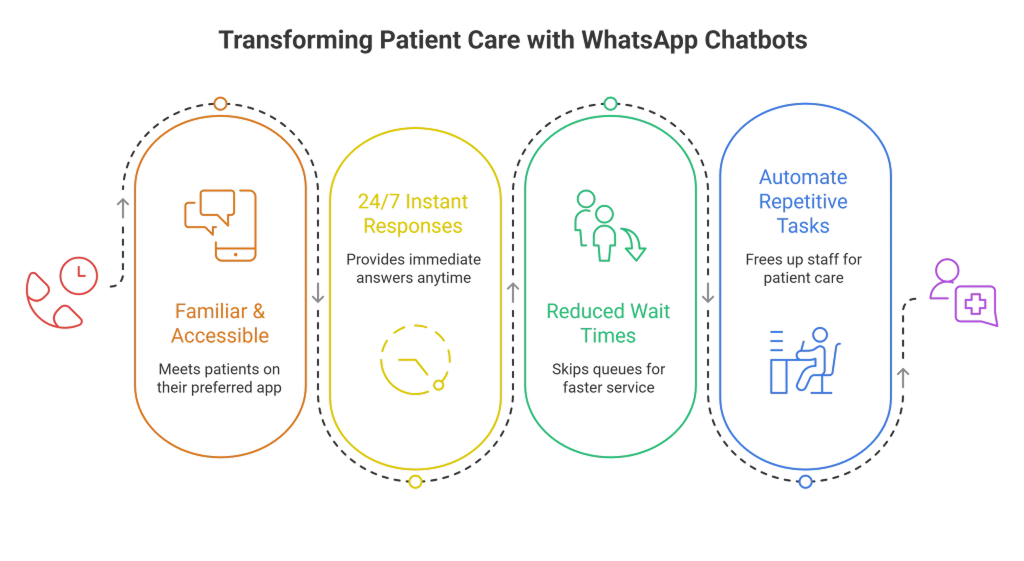
- WhatsApp meets patients where they are already familiar, easy to use, and always accessible.
- Ideal for quick interactions like booking appointments, getting updates, or asking basic questions
- Eliminates long wait times and phone calls
- Patients get instant responses 24/7
- Reduces staff workload by automating repetitive tasks like scheduling and follow-ups
- Brings speed, efficiency, and consistency to healthcare communication
- Improves patient satisfaction through faster, smoother interactions
Top 5 Best WhatsApp Chatbot Platforms in 2026
When it comes to healthcare, patient communication is a top priority. It acts as the gateway to the entire care journey, from initial inquiries to post-treatment follow-ups. In today’s digital world, using a universal platform like WhatsApp makes this communication even more effective, as it allows patients to connect with providers through an app they already use daily.
In 2026, WhatsApp chatbots are transforming this experience by enabling instant, automated, and personalized interactions. From appointment scheduling and reminders to handling patient queries and follow-ups, these solutions help healthcare providers streamline operations and improve patient engagement.
With several platforms offering advanced healthcare-specific features, choosing the right one is crucial.
1. Quad One AI WhatsApp Chatbot
The Quad One AI WhatsApp Chatbot is designed specifically for the healthcare industry, making it a highly practical and effective solution for hospitals, clinics, and diagnostic centers. Unlike general chatbot platforms, it focuses on solving real-world healthcare challenges such as managing patient interactions, reducing administrative workload, and improving communication efficiency.
Patients can easily book appointments, receive reminders, access reports, and get instant responses to their queries all within WhatsApp. This creates a seamless and familiar experience, eliminating the need for multiple apps or complicated systems.
One of its biggest strengths is its ability to understand natural language and respond in a conversational, human-like manner. It can guide patients based on symptoms, direct them to the right department, and support multiple languages, making it accessible to a broader audience.
Key Features
- AI-powered conversational chatbot with natural language understanding
- Appointment booking, rescheduling, and automated reminders
- Symptom-based guidance and smart patient triaging
- Multi-language support for diverse patient populations
- Integration with EHR/CRM systems for real-time data access
2. Happilee
Happilee is a well-rounded platform that combines simplicity with powerful features, making it suitable for a wide range of healthcare providers. Whether you are a small clinic or a large hospital, it offers the flexibility needed to manage patient communication effectively.
It enables teams to automate conversations, organize patient data, and personalize interactions without requiring deep technical knowledge. This makes it an excellent choice for organizations that want to adopt chatbot technology quickly and efficiently.
Key Features
- No-code/low-code chatbot builder for easy setup and deployment
- Automated patient conversations and response workflows
- Patient data management with organized interaction history
- Personalization capabilities for tailored patient communication
3. WATI
WATI is ideal for healthcare providers who handle a large number of patient interactions daily. Built on the official WhatsApp Business API, it focuses on improving response efficiency and team collaboration.
Healthcare teams can manage multiple conversations through a shared inbox, ensuring that every patient query is handled promptly. This is especially useful for larger hospitals where coordination between departments is critical.
Key Highlights
- Centralized inbox for team collaboration
- Easy chatbot setup with no coding required
- Broadcast messaging for reminders and updates
- Integration with CRM and hospital systems
WATI is a great choice for organizations that prioritize structured communication and need to manage high volumes without compromising on quality.
4. ManyChat
ManyChat is perfect for healthcare providers looking to expand beyond WhatsApp and manage communication across multiple platforms. It supports channels like Instagram and Facebook Messenger, allowing for a more connected patient engagement strategy.
Key Features
- Multi-channel messaging across WhatsApp, Instagram, and Facebook Messenger
- Visual flow builder for creating automated conversation journeys
- Automated campaigns for patient engagement and follow-ups
- Audience segmentation for targeted communication
5. AiSensy
AiSensy focuses on AI-powered engagement and is well-suited for healthcare providers looking to scale their communication efforts.
Key Features
- Smart AI chatbot responses
- Bulk messaging for campaigns and alerts
- Integration with external tools
- Analytics for performance tracking
WhatsApp Chatbot Comparison: Which Platform Is Right for Your Healthcare Practice?
With multiple WhatsApp chatbot platforms available, it’s important to choose one that aligns with your goals. While some tools focus on ease of use or marketing, others, like Quad One, are designed specifically for healthcare workflows. Here’s a quick comparison to help you decide.
| Features | Quad One | Happilee | WATI | Manychat | Aisensy |
| Suitable for | Best for healthcare organizations | Good for quick setup | Suitable for large teams | Works across multiple channels | Ideal for bulk campaigns |
| AI / NLP | Offers advanced AI capabilities | Provides basic AI features | Provides basic AI features | Has moderate AI capabilities | Offers advanced AI features |
| No-code builder | Does not have a no-code builder | Has a no-code builder | Has a no-code builder | Has a no-code builder | Has a no-code builder |
| Appointing booking | Fully supports appointment booking | Supports partially | Supports partially | Does not support | Does not support |
| Symptom triage | Supports symptom triage | Not available | Not available | Not available | Not available |
| EHR / CRM integration | Fully supports integration | Limited integration | Good integration support | Limited integration | Limited integration |
How to Choose the Best WhatsApp Chatbot Platform for Your Business
Selecting the right chatbot platform depends on your specific requirements. Larger healthcare organizations may need advanced automation and integrations, while smaller clinics may focus on ease of use and affordability.
Start by identifying your goals, whether it’s improving patient engagement, reducing manual workload, or scaling communication. Then evaluate platforms based on usability, integration capabilities, scalability, and overall value.
The best solution is one that fits naturally into your workflow and enhances patient experience without adding unnecessary complexity.
Conclusion
As healthcare embraces digital transformation, WhatsApp chatbots are becoming essential for faster communication, stronger patient engagement, and smoother daily operations. From appointment scheduling and reminders to basic support and follow-ups, they enhance every stage of the patient journey while reducing administrative burden for providers.
The Quad One AI WhatsApp Chatbot stands out with its healthcare-focused automation, offering features like smart appointment management, personalized communication, and seamless workflow integration. While other platforms support general use cases, Quad One is purpose-built for healthcare, helping organizations deliver more efficient, connected, and patient-centric care.
External References
Top 10 WhatsApp Chatbot Providers
10 Best AI Chatbots for Healthcare
The rise of telemedicine has significantly transformed healthcare by making care more accessible, efficient, and patient-centered. What began as a supplementary service has now become a core part of modern healthcare, especially accelerated by the COVID-19 pandemic. With the integration of artificial intelligence, e-consultation platforms have evolved into intelligent systems that support real-time patient interaction, symptom triage, appointment scheduling, and follow-ups.
AI-powered telemedicine enhances both patient experience and clinical efficiency. It reduces administrative workload, enables better data management, and allows healthcare providers to focus on high-value tasks. These platforms also improve accessibility by supporting multiple languages, assisting low-tech users, and reaching patients in remote areas. Seamless integration with electronic health records ensures continuity of care and more informed decision-making.
“These ongoing telemedicine trends are making care more accessible, efficient, and patient-centered.”
Telemedicine and the rise of online consultations
Telemedicine and online consultations have rapidly transformed how healthcare is delivered, making medical support more accessible and convenient than ever before. With the help of digital platforms, patients can now connect with doctors remotely for
diagnosis, follow-ups, and even ongoing treatment without the need for in-person visits.
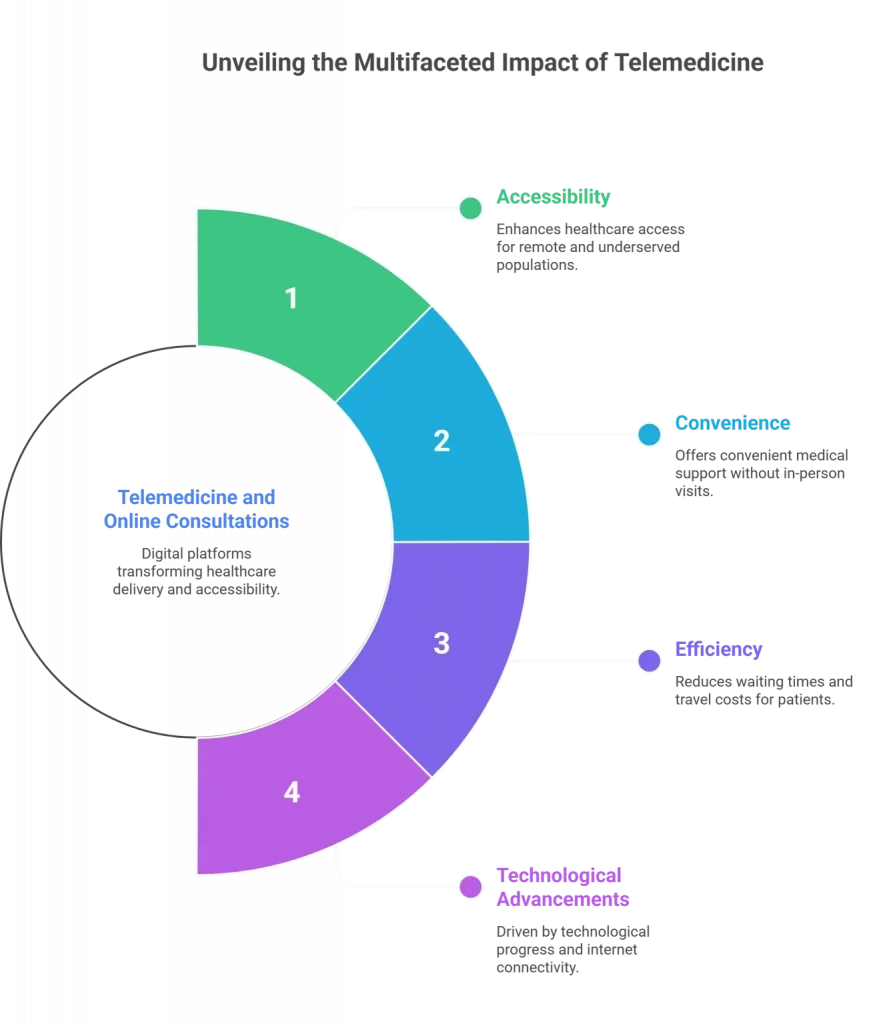
This shift has been driven by advancements in technology, increased internet access, and the growing demand for faster, more flexible care. Telemedicine not only helps reduce waiting times and travel costs but also plays a crucial role in reaching patients in remote or underserved areas. As healthcare continues to evolve, online consultations are becoming an essential part of modern care delivery.
What is Telemedicine?
Telemedicine is a way to get all your medical care needs met using technology such as phone calls, video calls, or mobile apps. It enables patients to connect with healthcare professionals remotely, making it easy to discuss symptoms, seek medical advice, receive diagnoses, and even get prescriptions without needing to visit a hospital or clinic in person.
Beyond basic consultations, telemedicine also supports follow-up care, routine check-ups, mental health services, and the management of chronic conditions like diabetes or hypertension. It helps reduce travel time, lowers healthcare costs, and improves access for people in remote or underserved areas.
Advantages of Telemedicine :
Telemedicine has played a significant role in making healthcare more efficient and convenient for both patients and providers. It helps reduce long waiting hours at hospitals and clinics, allowing patients to connect with doctors quickly and get timely medical advice without the hassle of travel. This not only saves time but also makes it easier for people to fit healthcare into their daily lives.
Patients can reach out to doctors as soon as they notice symptoms, which leads to faster diagnosis and early treatment. This quick access can make a real difference, especially in preventing minor issues from becoming serious health problems.
In many platforms, voice assistants in healthcare appointment booking also make it easier for patients to schedule or reschedule visits using simple voice commands, adding another layer of convenience.
Challenges and Limitations of Online Consultations
Telemedicine has definitely made some remarkable strides, but it also comes with its own set of limitations. One of the main challenges is the lack of physical examination, which can make it difficult for doctors to accurately diagnose certain conditions that require hands-on assessment or diagnostic tests.
Another limitation is the dependence on technology. Not everyone has access to a stable internet connection, smartphones, or the digital skills needed to use telehealth platforms effectively. This can create a gap, especially among elderly patients or those in underserved communities.
There are also concerns around data privacy and security, as sensitive medical information is shared online. In addition, some patients may feel that virtual consultations lack the personal touch and reassurance of face-to-face interactions with their doctors.
| Aspects | Telemedicine (Online Consultations) | In-Person Consultations |
| Accessibility | Easy access from anywhere with internet | Requires travel to the hospital |
| Time Efficiency | Saves time, no waiting in long queues | Often involves waiting time and travel |
| Physical Examination | Not possible or limited | Full physical check-up possible |
| Convenience | Highly convenient, can consult from home | Less convenient, requires scheduling and travel |
| Cost | Usually lower (no travel or related expenses) | Higher due to travel, time, and hospital costs |
| Personal Interaction | Less personal, virtual communication | More direct and personal interaction |
The Role of Online Consultations in the Future of Healthcare
Online consultations are shaping the future of telemedicine and key healthcare trends by making care more connected and patient-focused. People no longer have to depend only on physical visits. People no longer have to depend only on physical visits to get medical help; they can speak to a doctor anytime, from anywhere. This flexibility is especially helpful for those with busy schedules, limited mobility, or living in areas where healthcare facilities are not easily accessible. It brings a sense of comfort and ease, knowing that medical support is just a call or click away.
As healthcare continues to evolve, online consultations will become a natural part of everyday care. They will help doctors stay connected with patients even after treatment, ensuring better follow-ups and ongoing support. While hospitals and clinics will always remain important, virtual care will act as a strong support system, making healthcare faster, more efficient, and more responsive to people’s needs.
Conclusion:
Healthcare delivery has evolved rapidly in recent years, with telemedicine and online consultations playing a key role in making care more accessible and adaptable to modern lifestyles. From quick virtual consultations to AI-powered support systems, this shift has brought care closer to patients, breaking down barriers like distance, time, and availability. It has not only improved patient convenience but also allowed healthcare providers to work more efficiently and focus on delivering quality care.
While there are still challenges such as limited physical examinations, technology gaps, and data security concerns, the overall impact of telemedicine remains highly positive. As technology continues to advance, these limitations are likely to be addressed, making virtual care even more reliable and inclusive. In the coming years, telemedicine will not replace traditional healthcare but will work alongside it, creating a balanced, hybrid model that ensures better access, continuity, and quality of care for everyone.
