
Artificial Intelligence is rapidly redefining healthcare, making medical systems smarter, faster, and more patient-focused. What once began as small experiments is now becoming part of everyday healthcare, helping doctors detect diseases earlier, reduce documentation work, and improve hospital operations.
In 2026, the focus is not just on innovation but on using artificial intelligence in ways that deliver real value. Technologies like predictive analytics, remote patient monitoring, digital twins, and AI assistants are helping providers offer more personalized care while reducing administrative workload, gradually shifting healthcare toward a more proactive and data-driven approach.
Artificial intelligence in healthcare is revolutionizing medicine by enabling earlier disease detection, precise management, monitoring, and prevention. Integrated into clinical practice, AI tools analyze complex data from imaging scans, labs, and genetics, spotting subtle patterns humans might miss to shift healthcare from reactive treatment to predictive, precision care.
Why Artificial intelligence in healthcare Matters in 2026
The possibilities AI brings to healthcare are both extensive and game-changing. As innovation advances, AI is moving beyond a supportive role and actively transforming how medical care is provided, personalized, and continuously enhanced.
The future of artificial intelligence in healthcare is built on smart, patient-centric, and data-driven innovation. As these technologies advance, AI will evolve from being a supportive assistant to becoming a core driver of next-generation medical care and system-wide transformation.
| AI Area Impact | Description |
| Enhanced Early Detection. | Artificial intelligence Analyses Medical Images and data to detect early diseases. |
| Smart Clinical Decision Assistance. | AI enables faster, informed clinical decisions. |
| Digitally Driven Smart Hospitals. | Digitally Driven Smart Hospitals use AI and digital technologies for smarter. |
The Evolving Future of Artificial Intelligence in Healthcare
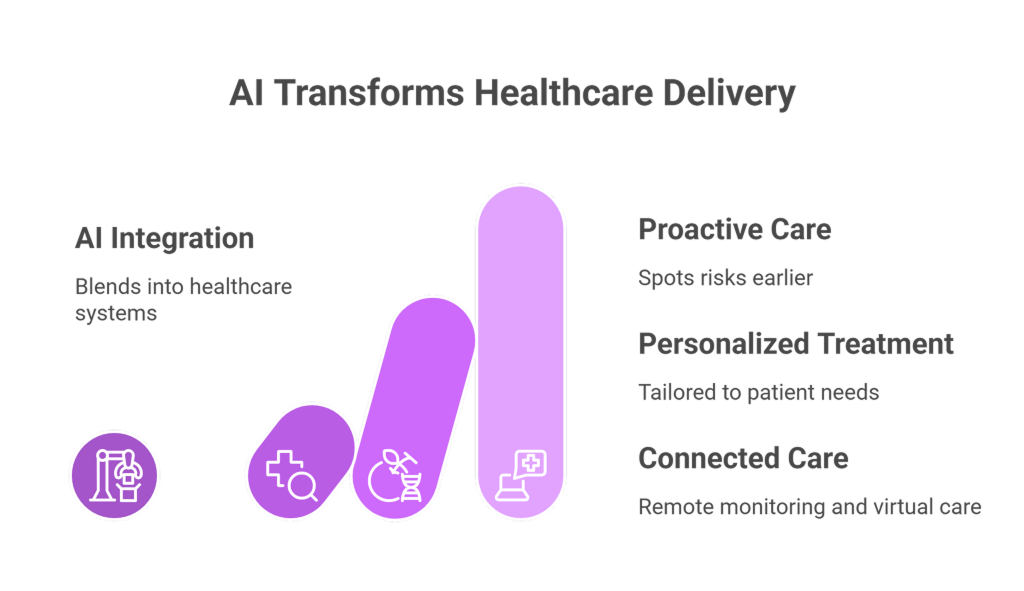
Artificial Intelligence is becoming a natural part of everyday healthcare. Instead of being a separate tool used occasionally, AI is slowly blending into hospital systems, clinical routines, and patient communication platforms, quietly supporting decisions behind the scenes.
The future of healthcare will be more proactive than reactive. With artificial intelligence analyzing real-time data, doctors can spot potential risks earlier, prevent complications, and create treatment plans that are more personalized to each patient’s needs.
Healthcare will also feel more connected and convenient. Through AI-powered remote monitoring and virtual care, patients can receive ongoing support from the comfort of their homes reducing unnecessary hospital visits while improving long-term health outcomes.
Top 10 AI Healthcare Trends in 2026
Artificial Intelligence in healthcare is evolving from limited trials and standalone applications into enterprise-wide solutions. In 2026, the emphasis is on scaling these technologies responsibly, delivering measurable clinical and financial impact, and embedding AI seamlessly into both care delivery and operational workflows.
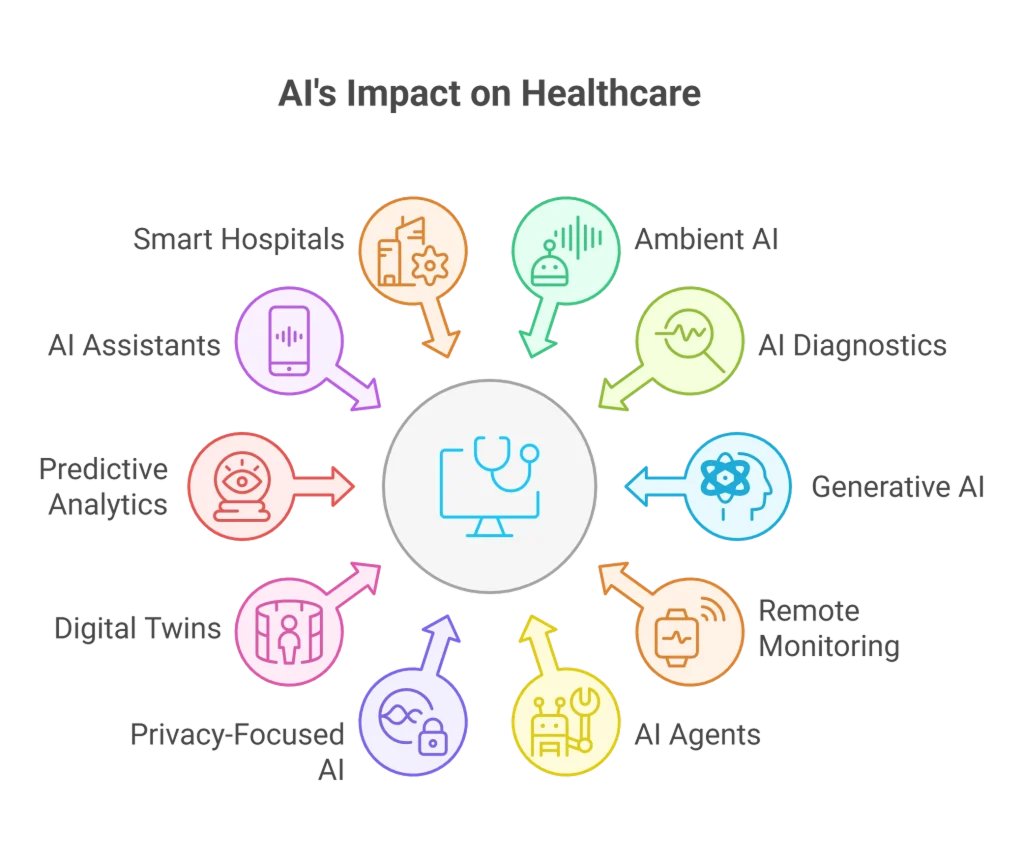
1. Ambient AI for Clinical Documentation
AI tools are making clinical documentation much easier by automatically capturing conversations between doctors and patients and turning them into organized medical notes. Working quietly in the background and leveraging prompt engineering in healthcare, these systems help reduce the time clinicians spend on paperwork, allowing them to focus more on listening to patients and providing better care
2. AI-Driven Medical Diagnostics
Artificial intelligence is helping doctors detect diseases earlier and with greater accuracy by analyzing medical images, pathology slides, and large amounts of clinical data. From spotting signs of cancer to identifying heart and eye conditions, AI-powered tools support clinicians in making quicker and more informed decisions about patient care.
3. Generative AI in Drug Discovery
Generative AI is helping researchers discover new medicines faster. It can predict how different molecules might work, simulate how drugs interact in the body, and identify promising treatment options. By speeding up these early research steps, artificial intelligence can reduce the time and cost needed to develop new therapies and bring them to patients sooner.
4. AI-Powered Remote Patient Monitoring
With the help of artificial intelligence and wearable devices, healthcare providers can monitor patients’vital signs even when they are at home. These systems continuously track health data and can alert doctors if something unusual appears. This makes it easier to catch potential health problems early and manage chronic conditions more effectively.
5. AI Agents for Healthcare Operations
AI agents are helping hospitals and clinics handle everyday administrative tasks more efficiently. They can assist with appointment scheduling, patient communication, billing, and medical coding. By taking care of routine tasks, these tools reduce the workload for staff and allow healthcare professionals to focus more on patient care.
6. Privacy-Focused AI Technologies
Since healthcare data is extremely sensitive, new AI technologies are being designed with privacy in mind. Approaches like federated learning allow organizations to train AI models while keeping patient data secure. This means hospitals can collaborate and improve AI systems without directly sharing confidential information.
7. Digital Twins and Personalized Medicine
Digital twin technology creates a virtual model of a patient using their medical history, genetic information, and lifestyle data. Doctors can use this model to better understand how a disease might progress and test different treatment options. This helps make healthcare more personalized and tailored to each individual patient.
8. Predictive Healthcare Insights
Healthcare providers can now identify potential health risks earlier with the help of artificial intelligenceand predictive analytics. By analyzing past patient data, lifestyle habits, and medical indicators, these tools can estimate the chances of diseases such as diabetes, heart disease, or hospital readmissions. This allows healthcare teams to take action sooner and focus more on prevention rather than treating conditions after they occur.
9. AI Medical Assistants
Smart conversational assistants are reshaping how patients interact with healthcare providers. Powered by AI, they can answer health-related questions, assist with symptom checks, remind patients about medications, and help schedule appointments. This instant, accessible support improves patient experience while reducing administrative pressure on healthcare staff.
10. Smart Hospital Operations
Artificial intelligence is becoming an important part of improving how hospitals operate. It helps healthcare organizations use their resources more effectively, reduce administrative burden, and enhance overall service delivery. By analyzing data such as patient flow, bed availability, staff schedules, and equipment usage, AI enables hospitals to make more informed and efficient operational decisions.
Typical Use Cases of AI in Healthcare
Artificial intelligence is transforming healthcare through a wide range of real-world applications that improve accuracy, efficiency, and patient outcomes. Some of the most common use cases of AI in healthcare include:
1. Medical Imaging and Diagnostics
AI-powered tools analyze X-rays, MRIs, and CT scans to detect diseases such as cancer, tumors, and fractures with high accuracy. This enables faster diagnosis and reduces the risk of human error.
2. Predictive Analytics
AI uses patient data to predict potential health risks, enabling early intervention and preventive care. Hospitals use predictive models to identify high-risk patients and reduce readmission rates.
3. Drug Discovery and Development
AI accelerates the drug discovery process by analyzing large datasets to identify potential compounds, reducing time and cost significantly.
4. Remote Patient Monitoring
Wearable devices powered by AI track patient vitals in real time, allowing healthcare providers to monitor patients remotely and respond quickly to health issues.
5. Clinical Decision Support Systems
AI assists doctors by providing data-driven insights and treatment recommendations, helping improve clinical decision-making and patient care.
From Promises to Proven ROI
ROI mainly focuses on the real value AI brings to the table rather than false expectations. Instead of viewing AI through a grand or futuristic lens, the real measure of its impact lies in what it delivers in real time, such as cost reduction, improved efficiency, and faster outcomes. The emphasis is not on exaggerated promises but on practical, measurable results. What truly matters is how AI supports daily operations by reducing human workload, streamlining processes, and enabling quicker decisions, ultimately proving its value through the tangible benefits it delivers
The Push for Organizational Readiness Is Growing
This actually assesses how ready the organization is to embrace the changes that will come as AI becomes the center of everything. It reflects how prepared the organization is to adapt to these changes. There are a few prerequisites that enable it to function to its full potential, such as strong technical foundations, proper employee training, and the flexibility to adapt whenever needed.
AI-human collaboration is taking shape
There is a common misconception that artificial intelligence can do things humans cannot and will eventually replace them, but this is not entirely true. In reality, AI and the human brain work best when they go hand in hand toward a common goal.
AI excels at processing large volumes of data within milliseconds and performing repetitive or rule-based tasks with high accuracy. On the other hand, humans bring context, critical thinking, creativity, and empathy, which are essential for meaningful decision-making and patient-centered approaches. When combined in this way, artificial intelligence and human expertise complement and support each other, creating a balanced system that improves efficiency and accuracy.
Creating AI projects that actually scale
Organizations often have small projects that lack the proper environment and supporting criteria needed for growth, which keeps them limited or underperforming. When AI comes into the picture, it helps elevate these projects by introducing better workflows, clearer data structures, and stronger support systems. By managing larger workloads and improving overall productivity, AI helps uplift the project and drive better outcomes.
AI in Healthcare Statistics (2026)
The adoption of AI in healthcare is rapidly increasing, driven by the need for efficiency, accuracy, and better patient outcomes. Here are some key statistics highlighting its impact:
- The global AI in healthcare market is expected to reach over $100 billion by 2026, driven by increased adoption across hospitals and research institutions.
- More than 70% of healthcare organizations are expected to integrate AI into their workflows by 2026.
- AI-powered diagnostics can improve accuracy by up to 30–40%, especially in imaging and early disease detection.
- Hospitals using AI-driven automation have reported 20–25% improvement in operational efficiency.
- Predictive analytics powered by AI can reduce hospital readmissions by up to 15–20%.
These statistics highlight how AI is shifting healthcare from a reactive model to a more proactive and data-driven system.
Future of Adoption of AI in Healthcare: Conclusion
Artificial intelligence has already made a significant impact in healthcare, clearly demonstrating the difference between systems that operate with AI support and those that do not. Its integration is helping improve efficiency, enhance decision-making, and streamline healthcare processes, showing the growing value of AI in modern medical environments.
