
Healthcare systems worldwide are under immense pressure to balance operational efficiency with delivering timely, personalised patient care. Traditional appointment booking methods, primarily phone calls or online forms, often lead to bottlenecks, staff overload, and suboptimal patient experiences. Voice assistants for healthcare appointment booking are changing this dynamic. These AI-powered systems use natural language processing (NLP) to engage with patients via speech, allowing them to schedule, modify, or cancel appointments using simple spoken commands, 24/7, without call queues.
| Quick Answer : Voice assistants streamline healthcare appointment booking by using natural language processing (NLP) to let patients schedule, modify, or cancel appointments via voice commands — 24/7, without call queues. Integrated with EHR and CRM systems via FHIR APIs, they reduce no-show rates by up to 72%, cut cost-per-booking from $8–15 to $1–3, and free staff from up to 38% of administrative scheduling workload. |
Voice scheduling is one component of a broader AI in healthcare transformation that is reshaping how hospitals operate, engage patients, and deliver care.
Whether it is booking a consultation with a general practitioner or scheduling a specialised diagnostic test, voice assistants offer real-time interaction that mirrors human-like conversation. This guide covers how they work, how they integrate with hospital systems, what results leading hospitals are seeing, and how the technology is evolving.
Traditional vs. AI-Powered Healthcare Appointment Booking: A Full Comparison
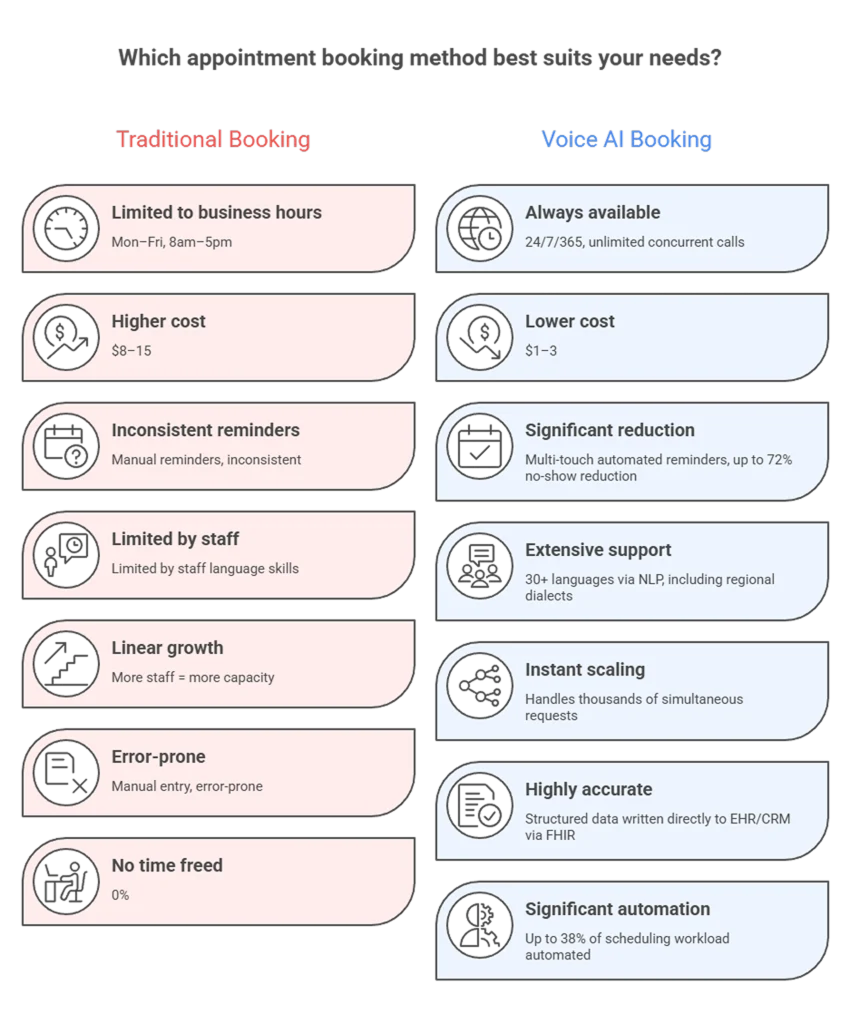
Before evaluating voice assistants, it helps to understand exactly what they replace. The table below compares traditional phone-and-form scheduling against AI-powered voice booking across the dimensions that matter most to hospital operations teams.
Availability. Traditional booking is limited to business hours and staff capacity. Voice assistants operate 24/7, handling simultaneous requests without hold times.
Cost per booking. Manual scheduling typically costs $8–15 per appointment when factoring in staff time, phone infrastructure, and error correction. AI voice agent healthcare reduces this to $1–3 per booking by automating the entire workflow.
No-show management. Phone-based reminders are inconsistent and resource-intensive. Voice assistants deliver multi-touch, personalised reminders at optimal intervals (72 hours and 24 hours before the appointment), with one-tap confirm or reschedule options, cutting no-show rates by up to 72%.
Language support. Traditional call centres require multilingual staff, which is expensive and hard to scale. Voice assistants handle dozens of languages natively using NLP models, making healthcare access equitable across diverse patient populations.
Scalability. Adding call centre capacity means hiring, training, and managing more staff. voice AI healthcare appointment scheduling scales instantly during peak demand (flu season, vaccination drives, outbreaks) without additional headcount.
Data capture. Manual booking often results in incomplete or inaccurate patient records. Voice assistants capture structured data (patient ID, appointment type, preferred provider, insurance details) and write it directly to the EHR and scheduling system in real time.
How Do Voice Assistants Work for Healthcare Scheduling?
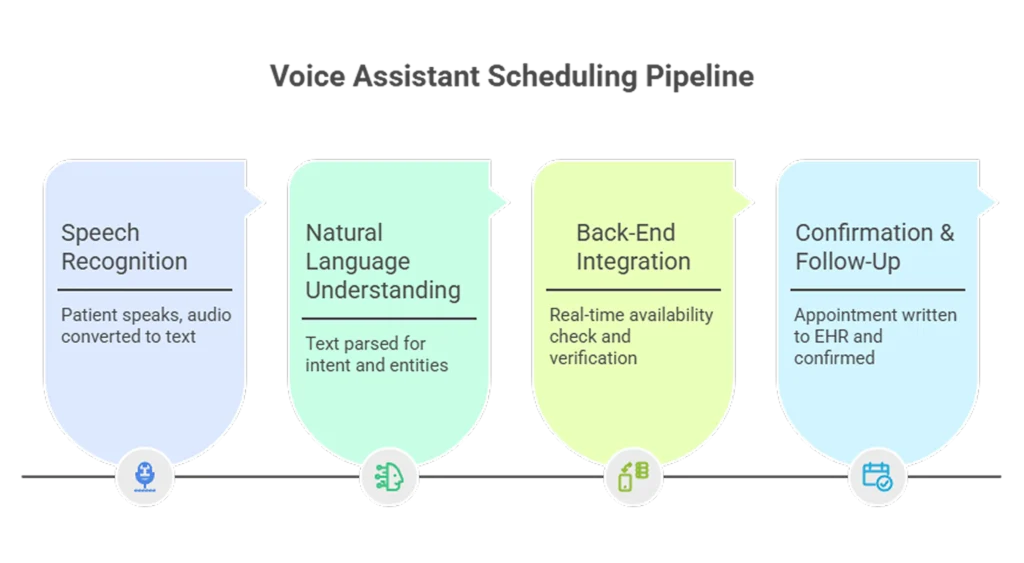
A voice assistant for healthcare scheduling operates through a four-stage pipeline that converts spoken patient input into a confirmed appointment record inside the hospital’s systems.
Stage 1: Speech Recognition. The patient speaks naturally (“I need to see Dr. Patel next Thursday afternoon”). Automatic speech recognition (ASR) converts the audio to text. Modern ASR models handle accents, medical terminology, and background noise with accuracy rates above 95%.
Stage 2: Natural Language Understanding (NLU). The NLU engine extracts intent (book, reschedule, cancel) and entities (provider name, date, time preference, appointment type). It disambiguates: “next Thursday” becomes a specific calendar date; “afternoon” maps to available slots between 12:00 and 17:00.
Stage 3: Back-End Integration. The system queries the scheduling engine via FHIR APIs to check real-time provider availability, patient eligibility, and insurance coverage. If the requested slot is unavailable, the assistant proposes alternatives ranked by proximity to the patient’s preference.
Stage 4: Confirmation and Follow-Up. The assistant confirms the booking, writes the appointment to the EHR, and triggers a confirmation message through the patient’s preferred channel (voice callback, SMS, WhatsApp, email). Automated reminder sequences are scheduled (72h + 24h) with one-tap reschedule links.
Technical Integration: Connecting the Voice agent healthcare to Hospital Systems
For hospital administrators and Health IT professionals, the most significant advantage of voice assistants is their ability to integrate securely and effectively with back-end infrastructure. Successful implementations typically include EHR and scheduling system integration to enable real-time availability checks and booking updates, Natural Language Understanding (NLU) capabilities to support multilingual patient interaction, omni-channel deployment via smart devices, mobile apps, and IVR phone systems, and FHIR-compatible APIs for standardised data exchange.
Voice assistants use FHIR (Fast Healthcare Interoperability Resources) APIs to securely exchange standardised healthcare data. These APIs enable voice systems to access appointment slots, patient records, and provider availability through consistent formats, reducing integration time by 30–40% compared to custom approaches.
When voice scheduling is connected to an AI hospital CRM, the booking data feeds directly into patient engagement workflows: automated pre-visit prep, post-visit follow-ups, and feedback collection all trigger from the same appointment event.
HIPAA compliance is non-negotiable. Voice data must be encrypted during transmission and at rest. Patient identity verification (date of birth, MRN, or biometric voice print) must precede any access to Protected Health Information. Audit logs must record every interaction. Leading implementations use end-to-end encryption and store voice recordings only when explicit patient consent is captured.
Real-World Results: How Leading Hospitals Use Voice Assistants
United States
Leading healthcare systems including Kaiser Permanente, Cleveland Clinic, Providence Health, and Mass General Brigham have implemented voice assistants for scheduling. Key technology providers include Microsoft Healthcare Bot, Google Health AI, and Amazon Comprehend Medical. Northeast Medical Group implemented a voice-first scheduling system and experienced significant improvements in booking completion rates and staff time savings.
Healthcare organisations like Cleveland Clinic and Mayo Clinic are now leveraging advanced voice capabilities to not only schedule appointments but also help prioritise urgent cases and suggest appropriate care levels based on symptom description.
In India, the combination of voice assistants and WhatsApp patient communication offers massive reach, especially in semi-urban and rural areas where voice-first interaction is the natural digital entry point, showing how AI WhatsApp bots are changing patient access by making support available through familiar everyday channels.
India
Apollo Hospitals deployed an Alexa-based voice skill linked to its internal scheduling systems. Later enhanced with multilingual support through WhatsApp and mobile platforms, Apollo reported a 49% increase in appointment bookings, particularly from regions with limited digital literacy. Their latest update added support for 8 regional languages, allowing them to reach over 80% of the Indian population in their native language.
In India, the combination of voice assistants and WhatsApp patient communication offers massive reach, especially in semi-urban and rural areas where voice-first interaction is the natural digital entry point.
Middle East
Medcare Hospitals in the UAE launched an AI assistant capable of handling bookings, cancellations, and rescheduling in real time. With Arabic-English bilingual capabilities and backend system integration, the assistant significantly improved both patient satisfaction and staff productivity. The UAE Ministry of Health has since established new standards for voice assistant implementation, making it part of their 2025 healthcare digitisation initiative.
These regional case studies share a common success factor: seamless integration with existing hospital systems (scheduling engines, CRMs, EHRs) combined with the ability to deliver a responsive, voice-enabled interface localised for the patient population.
How Do Voice Assistants Reduce No-Show Rates?
No-shows are one of healthcare’s most expensive blind spots. In the US alone, missed appointments are estimated to cost providers more than $150 billion annually. Voice assistants attack no-shows through three mechanisms.
Multi-touch, personalised reminders. Unlike generic SMS blasts, voice assistants deliver conversational reminders at optimal intervals. They call the patient, confirm intent, and offer one-tap rescheduling if the patient cannot make it. The conversational format drives higher engagement than text-only reminders.
Predictive no-show identification. AI models analyse historical attendance patterns, demographic factors, and appointment characteristics to flag high-risk patients. These patients receive enhanced engagement: additional reminder touchpoints, transportation assistance information, and proactive outreach from staff.
Instant waitlist backfill. When a patient cancels or reschedules, the voice assistant immediately contacts waitlisted patients with matching availability preferences and books the open slot in real time. This preserves clinic capacity that would otherwise be lost.
The Future of Voice Assistants in Healthcare Scheduling
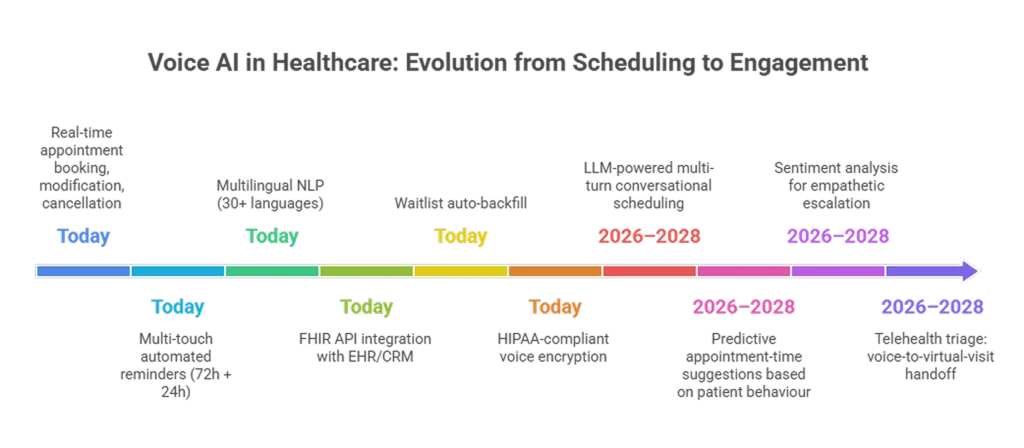
The latest voice assistants are transcending basic scheduling functionality and are closely tied to the future of telemedicine key trends, where intelligent, always-available virtual front doors become a standard part of care delivery.
Large Language Models (LLMs) that enable more natural, context-aware conversations with patients. Instead of rigid slot-filling dialogues, the assistant can handle complex multi-turn requests (“I need to see my cardiologist sometime next week, but not Tuesday, and I’d prefer morning”) in a single conversational flow.
Predictive analytics that suggest optimal appointment times based on historical data and patient preferences. Systems at MetroHealth and Johns Hopkins are already using this to reduce scheduling friction.
Sentiment analysis that detects patient stress or confusion and adjusts responses accordingly, slowing down, simplifying language, or escalating to a human agent.
Integration with telehealth platforms for seamless virtual care transitions is accelerating. Learn more about Quad One’s AI telemedicine solution and how voice-booked appointments can transition between in-person and virtual modalities based on clinical need.
The next generation of voice solutions will not only streamline bookings but also support triage, medication adherence, and chronic disease management, turning the scheduling touchpoint into a broader patient engagement channel.
Implementation Playbook: Getting Started with Voice Scheduling
For hospital executives, innovation leaders, and health IT professionals looking to implement voice assistants, the following action steps provide a structured path to deployment:
Step 1: Audit current scheduling inefficiencies. Quantify call volumes, average hold times, no-show rates, cost-per-booking, and staff time spent on scheduling. This establishes the baseline for ROI measurement.
Step 2: Define integration requirements. Map the voice assistant’s data needs: which EHR fields, scheduling engine APIs, and patient identity verification methods are required. Confirm FHIR API availability from your EHR vendor.
Step 3: Start with a single high-volume use case. New patient appointments or follow-up scheduling are ideal pilots. Limit scope to one department or clinic to prove value before expanding.
Step 4: Configure multilingual and omni-channel support. Prioritise the languages spoken by your patient population. Deploy across the channels patients already use: phone (IVR), mobile app, smart speakers, and WhatsApp.
Step 5: Measure and iterate. Track booking completion rate, no-show rate delta, cost-per-booking reduction, and patient satisfaction scores. Use A/B testing for reminder timing, channel, and conversational style.
Conclusion
Voice assistants in healthcare do not just enhance operational efficiency. They play a vital role in advancing patient-centric care by removing friction from the first touchpoint most patients have with a hospital: booking an appointment. By automating and personalising the scheduling process, they help healthcare providers reduce administrative burden, cut no-show rates, lower cost-per-booking, and free clinical and front-desk staff to focus on higher-value interactions.
The integration of voice assistants with EHR, CRM, and telehealth platforms means the scheduling interaction becomes the starting point for a connected patient journey, not an isolated transaction.
As these systems evolve alongside conversational tools, hospitals can also leverage how chatbots improve patient engagement by extending the same intelligent, automated experience beyond booking into reminders, education, and ongoing follow-up.
Book a demo to see how Quad One’s AI-powered voice and scheduling solutions connect appointment booking, patient engagement, and clinical workflows in one platform.
The healthcare sector has seen a decisive shift toward value-based care, where reimbursement hinges on patient outcomes rather than the volume of services delivered. At the centre of this shift is the AI hospital CRM, a system that goes beyond traditional patient relationship management by embedding predictive analytics, risk stratification, and automated care coordination directly into hospital workflows. For hospitals operating under value-based payment models, bundled payments, or Accountable Care Organisation (ACO) contracts, an AI-driven CRM is no longer a nice-to-have; it is operational infrastructure.
Quad One’s AI-powered hospital CRM is purpose-built for this environment, connecting clinical data, engagement workflows, and outcome measurement in a single platform. It also acts as an AI healthcare compliance guide in practice, helping hospitals align clinical workflows, reporting, and data usage with regulatory expectations. This guide covers how AI hospital CRM improves outcomes in value-based care settings
This guide covers how AI hospital CRM improves outcomes in value-based care settings, from risk stratification and readmission reduction to personalised care plans, care coordination, ACO reporting, and measurable ROI.
Key Takeaways
- AI-driven risk stratification identifies high-risk patients before they become high-cost patients.
- Hospitals using AI hospital CRM for readmission prevention have reported up to 25% fewer chronic-disease readmissions.
- Personalised AI care plans increase patient satisfaction scores by up to 30% compared to non-personalised approaches.
- ACO and bundled-payment reporting becomes automated, not manual, when the CRM tracks outcomes natively.
- ROI materialises through lower readmission penalties, reduced administrative labour, and improved quality-incentive payments.
What Is Value-Based Care and Why Does AI Hospital CRM Matter?
Value-based care (VBC) is a reimbursement model that rewards hospitals for the quality and efficiency of care delivered, not the number of procedures performed. Under VBC contracts, including Medicare’s Hospital Value-Based Purchasing (VBP) program, bundled payments, and ACO shared-savings arrangements, hospitals earn or lose revenue based on clinical outcomes, patient satisfaction, and cost reduction.
Traditional hospital CRMs were designed for scheduling and marketing. They lack the predictive intelligence required to manage risk, coordinate multidisciplinary care, and report outcomes at the granularity VBC demands. An AI hospital CRM closes this gap. It ingests clinical, demographic, and behavioural data; applies machine learning models for risk prediction; automates outreach and follow-up workflows; and generates audit-ready outcome reports for payer contracts.
The result: hospitals can shift from reactive care delivery to proactive population health management, which is the operational foundation of every successful VBC programme.
AI-Powered Risk Stratification: Identifying High-Risk Patients Early
Integrating AI in healthcare CRMs enhances predictive analytics capabilities, allowing providers to identify at-risk patient populations proactively. This enables timely intervention, essential in preventive care strategies, and significantly reduces hospital readmissions while improving long-term outcomes.
AI-driven algorithms analyse extensive patient data, including medical history, lifestyle factors, lab trends, social determinants, and previous hospital utilisation patterns, to predict health risks accurately. Unlike static scoring models, AI risk stratification updates dynamically as new data flows in: a patient whose blood pressure trends upward over three consecutive visits gets flagged before they present at the emergency department.
With these insights, healthcare providers can focus resources more efficiently, ensuring that the right patients receive timely preventive measures. One notable healthcare institution implemented AI-driven risk stratification through their hospital CRM, resulting in a 25% decrease in hospital readmissions for chronic diseases. This improvement was achieved by identifying high-risk patients early, delivering personalised interventions, and closely monitoring patient progress.
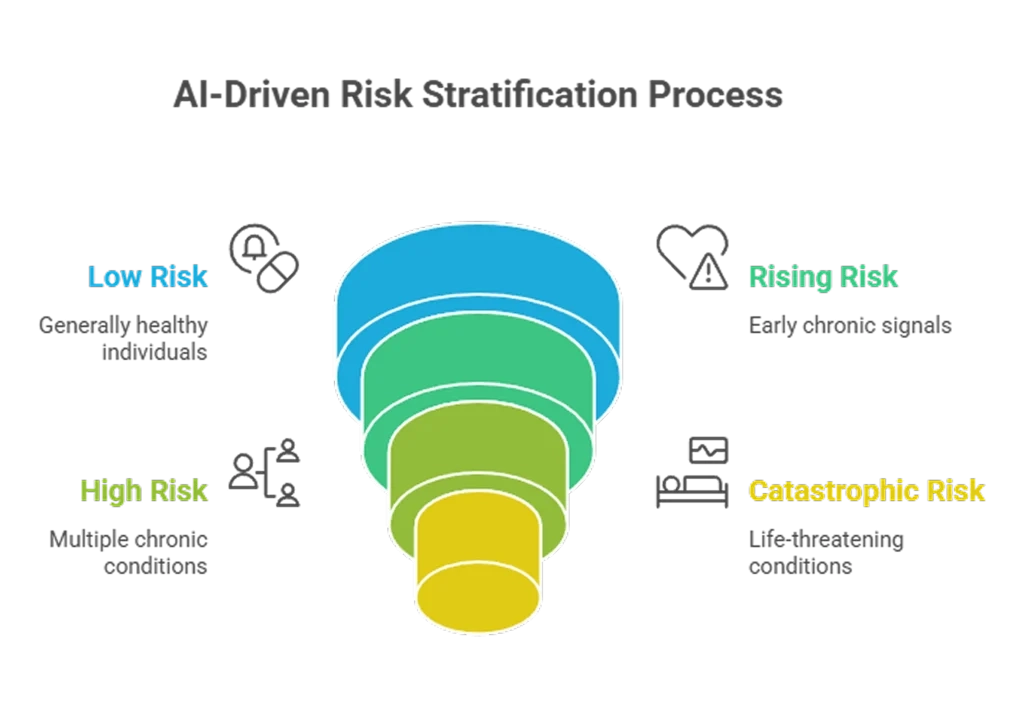
Risk tiers typically break into four groups: low-risk (healthy, preventive care focus), rising-risk (early chronic signals, early intervention), high-risk (multiple chronic conditions, coordinated ongoing care), and catastrophic-risk (life-threatening conditions, intensive specialised management). The CRM assigns care pathways and outreach cadences based on each tier.
How Does AI Hospital CRM Reduce Readmissions?
Readmission penalties under Medicare’s Hospital Readmissions Reduction Program (HRRP) cost US hospitals hundreds of millions of dollars annually. For VBC-contracted hospitals, every avoided readmission directly improves shared-savings calculations and
quality scores. AI hospital CRM attacks readmissions at three points: before discharge, during the transition window, and in the weeks that follow.
Pre-Discharge: Structured Handoff Workflows
The CRM ensures that discharge instructions, medication reconciliation summaries, and follow-up appointment details are delivered through the patient’s preferred channel before they leave the facility. Teach-back confirmation prompts verify the patient understood the plan. If confirmation is not received, the system escalates to a care coordinator.
Transition Window (0–72 Hours)
An automated 48-hour post-discharge call or message checks symptom status, medication access, and home-care setup. AI models flag patients whose responses indicate elevated re-hospitalisation risk, such as reported difficulty obtaining medications or worsening symptoms, and route them to a nurse callback queue.
Ongoing Follow-Up (7–30 Days)
Weekly automated check-ins, refill reminders, and referral-to-appointment tracking keep the patient on track. The CRM monitors whether scheduled follow-ups are attended and, if not, triggers escalation. For chronic-disease patients, the system tracks lab values and vital trends, alerting care teams to intervening deterioration before it leads to an ED visit.
For a broader view of how CRM-powered workflows operate across the full patient journey, see our guide on hospital CRM patient experience improvements.
How Do AI-Driven Personalised Care Plans Improve Outcomes?
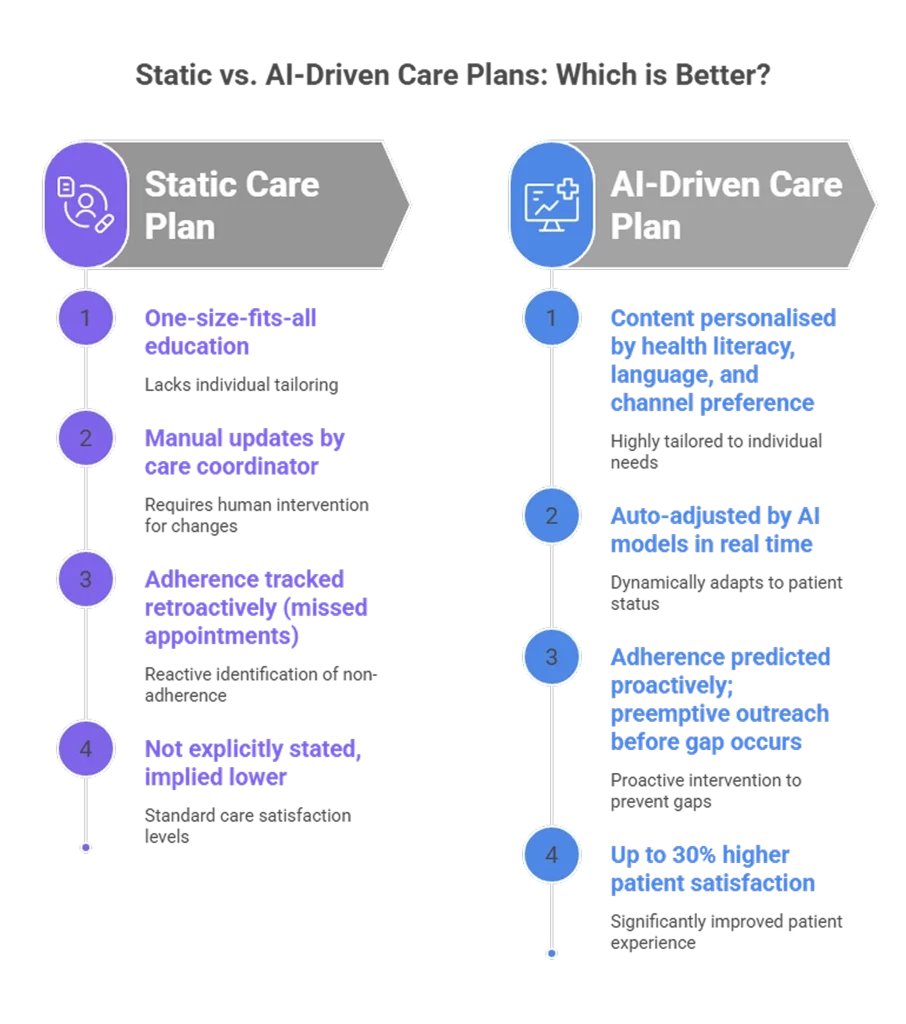
Personalised patient care plans are becoming an essential component of value-based care. By leveraging AI insights from CRM data, hospitals can create highly tailored care plans that address individual patient needs, preferences, and health goals. These AI-driven personalised care plans enhance patient engagement, treatment adherence, and ultimately improve healthcare outcomes.
Here is how the AI layer adds value beyond what traditional care planning delivers:
Dynamic plan adjustment. Unlike static care plans written at discharge, AI-driven plans update continuously as new data arrives. A patient’s A1C result worsens? The CRM automatically adjusts outreach frequency, adds dietary education content, and alerts the endocrinologist.
Behavioural and preference modelling. The AI analyses which communication channels, message times, and content types drive the highest engagement for each patient segment. A patient who consistently ignores emails but responds to WhatsApp messages gets routed to WhatsApp automatically.
Adherence prediction. Machine learning models predict which patients are likely to fall off their care plan based on historical patterns, enabling preemptive outreach before a gap occurs rather than reactive follow-up after one.
Research indicates that personalised patient care significantly improves both satisfaction and clinical outcomes. Hospitals implementing AI-enhanced personalised care have reported up to 30% higher patient satisfaction scores compared to those without such systems.
AI-Enhanced Care Coordination Across Multidisciplinary Teams
Care coordination is critical in value-based healthcare delivery. Hospital CRMs enhanced with AI facilitate better communication and collaboration among multidisciplinary healthcare teams. Real-time data access, automated workflows, and predictive insights help reduce errors, minimise redundant tasks, and improve overall patient care quality.
In practice, this means the primary care physician, specialist, social worker, pharmacist, and care manager all see the same real-time patient dashboard. When a cardiologist updates a medication, the CRM notifies the PCP and adjusts the patient’s refill reminder sequence. When a social worker logs a housing instability flag, the system adds social-determinant-aware outreach to the care plan. No manual handoffs. No missed signals.
A leading healthcare provider utilising AI-driven CRM technology observed significant cost savings and improved patient outcomes through enhanced care coordination. With real-time updates accessible to all healthcare providers involved, redundancies were drastically reduced, patient safety improved, and costs associated with unnecessary interventions were notably diminished.
Data Analytics and Outcome Measurement in Value-Based Care
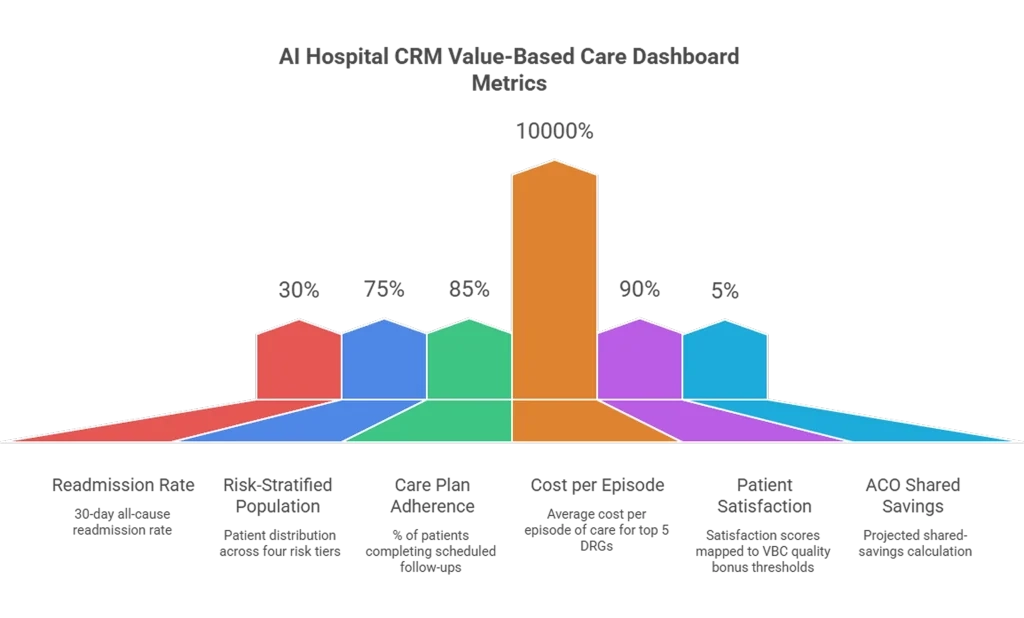
AI-enabled hospital CRMs offer robust data analytics and outcome measurement capabilities. Providers can track critical metrics such as hospital readmission rates, patient satisfaction scores, and preventive care effectiveness. This ability to systematically analyse outcomes enables continuous, data-driven improvements, aligning closely with the principles of value-based care.
Hospitals adopting AI analytics within their CRM platforms have reported substantial improvements in clinical outcomes and patient satisfaction. One healthcare network experienced a 15% improvement in clinical quality metrics within a year of AI-driven CRM implementation. Data-driven insights allowed for targeted interventions, optimised resource allocation, and improved preventive care strategies.
The dashboard should connect interventions to results: risk-stratified outreach volumes mapped to readmission-rate changes; care-plan adherence scores mapped to cost-per-episode trends; and referral completion rates mapped to specialist utilisation. Without this closed loop, VBC reporting is guesswork.
How AI CRM Supports ACO and Bundled Payment Reporting
Accountable Care Organisations (ACOs) and bundled-payment programmes require hospitals to report granular outcome data to CMS and commercial payers. This includes quality measures (often drawn from CMS’s ACO quality measure set), cost benchmarks, and patient-reported outcomes. Manually compiling these reports is labour-intensive, error-prone, and typically months behind the data.
An AI hospital CRM automates this process. It continuously aggregates clinical, engagement, and cost data against the specific measures required by each contract. Quality measure numerators and denominators are calculated in real time. Gaps in care that would drag down a quality score are flagged immediately, giving care teams time to intervene before the reporting period closes.
For bundled-payment programmes, the CRM tracks cost-per-episode against the target price, alerts administrators when an episode is trending over budget, and identifies the cost drivers (unplanned readmission, extended length of stay, post-acute care utilisation). This turns VBC reporting from a retrospective compliance exercise into a prospective management tool.
Overcoming Implementation Challenges
Despite clear benefits, integrating AI into existing hospital CRM systems presents several challenges that healthcare decision-makers should address proactively.
Data integration complexity. AI models require clean, normalised data from multiple sources: EHR, claims, pharmacy, and sometimes wearables. Hospitals with fragmented IT ecosystems need an interoperability layer (FHIR-based APIs are the industry standard) to unify data before AI can deliver value.
Staff adoption. Clinicians and care coordinators need to trust AI recommendations. A phased rollout, beginning with a single high-impact use case like readmission prediction, builds confidence through visible results before expanding to broader population-health workflows.
ROI clarity. Hospital decision-makers may hesitate without a clear understanding of financial returns. Frame ROI around avoided readmission penalties, reduced administrative FTEs for manual outreach and reporting, and improved quality-incentive payments from payer contracts.
Data security. Data security. AI-driven CRM systems store vast amounts of patient data. HIPAA-compliant encryption, role-based access controls, and continuous audit logging are non-negotiable, making hospital CRM privacy and compliance a core design requirement, not an afterthought. The CRM vendor must sign a Business Associate Agreement (BAA) and demonstrate SOC 2 or equivalent security certification.
For a deeper look at where AI-driven CRM is heading, explore our piece on the future of AI in hospital CRM.
What ROI Can Hospitals Expect from AI CRM in Value-Based Care?
The financial case for AI hospital CRM in VBC environments rests on four pillars:
1. Avoided readmission penalties. Medicare’s HRRP penalises hospitals up to 3% of base DRG payments for excess readmissions. An AI CRM that reduces chronic-disease readmissions by 25% can translate to hundreds of thousands of dollars in avoided penalties for mid-sized hospitals.
2. Quality-incentive payments. Under the VBP program and ACO contracts, hospitals that hit quality thresholds earn bonus payments. AI-driven outreach that improves care-plan adherence and patient satisfaction directly boosts the quality scores that determine these payments.
3. Administrative labour savings. Automating post-discharge calls, referral follow-ups, care-gap outreach, and VBC reporting reduces the FTE burden on care coordination and quality teams. Hospitals report 20–30% better utilisation of clinical staff time after CRM automation.
4. Reduced cost per episode. Better risk stratification and proactive management keep patients out of high-cost settings (ED, inpatient). For bundled-payment contracts, lower cost-per-episode means a higher margin.
AI automation reduces labour costs, minimises appointment no-shows, and increases overall hospital efficiency, leading to substantial financial returns. Hospitals should expect to see measurable ROI within 12–18 months of full deployment, with the strongest early returns in readmission avoidance and reporting automation.
Conclusion
The integration of AI in hospital CRM systems represents a transformative opportunity to enhance value-based care outcomes significantly. By improving risk stratification, delivering personalised patient care, optimising care coordination, and automating VBC reporting, hospitals can achieve better clinical outcomes, higher patient satisfaction, and greater operational efficiency.
Healthcare decision-makers must proactively embrace AI-driven CRM solutions to fully realise these benefits and meet evolving patient expectations and payer requirements.
AI-powered hospital CRM from Quad One delivers advanced patient engagement, streamlined workflows, and powerful analytics to improve healthcare outcomes in value-based care environments.
Book an AI Hospital CRM Demo to see how Quad One’s platform connects risk stratification, care coordination, and outcome reporting into one system built for value-based care.
