
Hospitals are under pressure to expand access, improve patient experience scores, and operate with fewer manual steps. A modern hospital CRM ties together communications, preferences, and feedback with clinical context to make every touchpoint timely, relevant, and safe. Evidence shows that engaging patients and families improves safety and quality, and that systematic measurement via HCAHPS (Hospital Consumer Assessment of Healthcare Providers and Systems) directly links experience to reputation and reimbursement.
This guide walks through how a hospital CRM works across the full patient journey, how it maps to HCAHPS domains, what interoperability looks like in practice, and how to measure what matters. Whether you are evaluating CRM platforms for the first time or looking to tighten your existing patient engagement workflows, every section below is designed to be actionable.
Key Takeaways
- CRM vs. EHR: The EHR is the clinical system of record. The CRM is the engagement engine that communicates and acts on that truth.
- Beyond Marketing: A hospital CRM is an operational tool for scheduling, pre-visit preparation, in-visit communication, post-discharge follow-up, and service recovery.
- Measurable Impact: The right CRM strategy delivers direct gains in no-show rates, HCAHPS scores, and referral-to-appointment times.
What Is the Difference Between a Hospital CRM and an EHR?
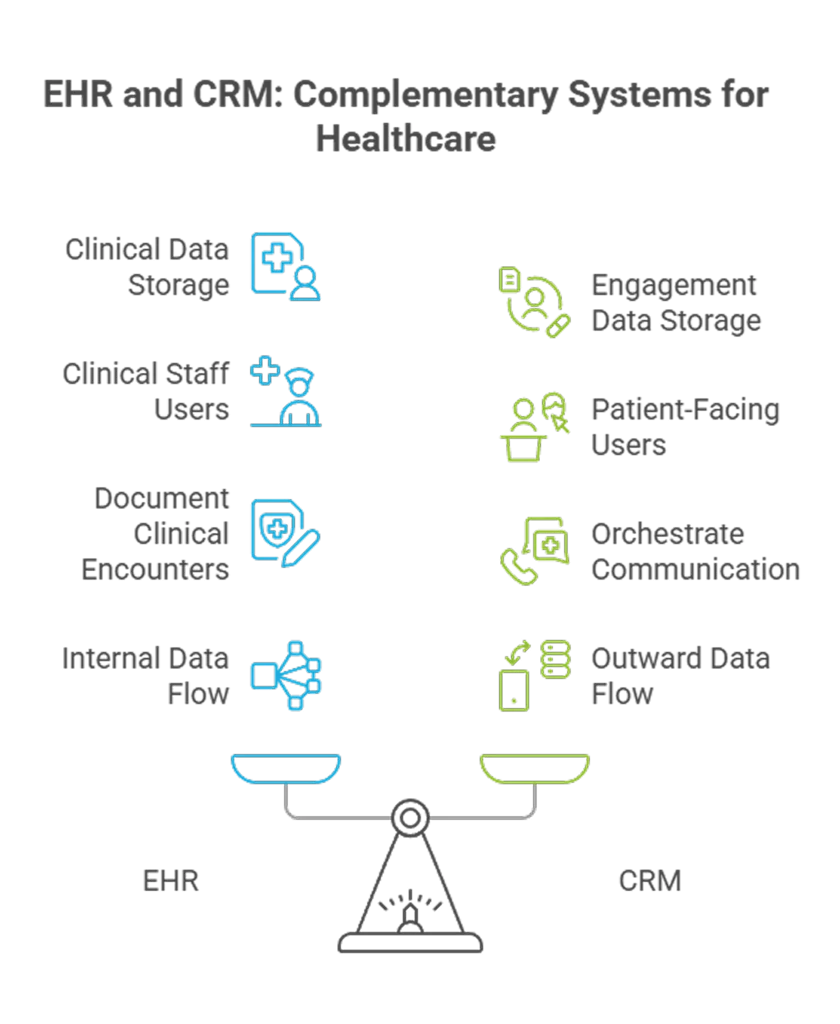
Think of the Electronic Health Record (EHR) as the clinical source of truth. It stores diagnoses, medications, lab results, and care plans. A hospital CRM, on the other hand, is the engagement engine that orchestrates communication and service recovery around that clinical truth.
A fit-for-purpose CRM listens for events (appointment booked, order placed, discharge complete) and triggers the right message on the right channel with full auditability. The EHR tells you what happened clinically. The CRM decides what to say, when, and how.
An AI-powered hospital CRM takes this further by using machine learning to personalize message timing, channel selection, and content based on each patient’s history and preferences.
Strong patient data management links identity, language, consents, and social context to clinical milestones. This enables personalized patient care without oversharing Protected Health Information (PHI). Omnichannel programs covering SMS, WhatsApp, email, IVR, and patient portals should be throttled by audience, timing, and sensitivity.
How Does a Hospital CRM Improve the Patient Journey?
Patient journey tracking means each step, from referral received to appointment scheduled, visit completed, and results posted, can trigger a contextual nudge. That is modern healthcare workflow automation: rules and AI work in the background so humans can focus on conversations that need a human.
Pre-Visit: Scheduling, Reminders, and Preparation
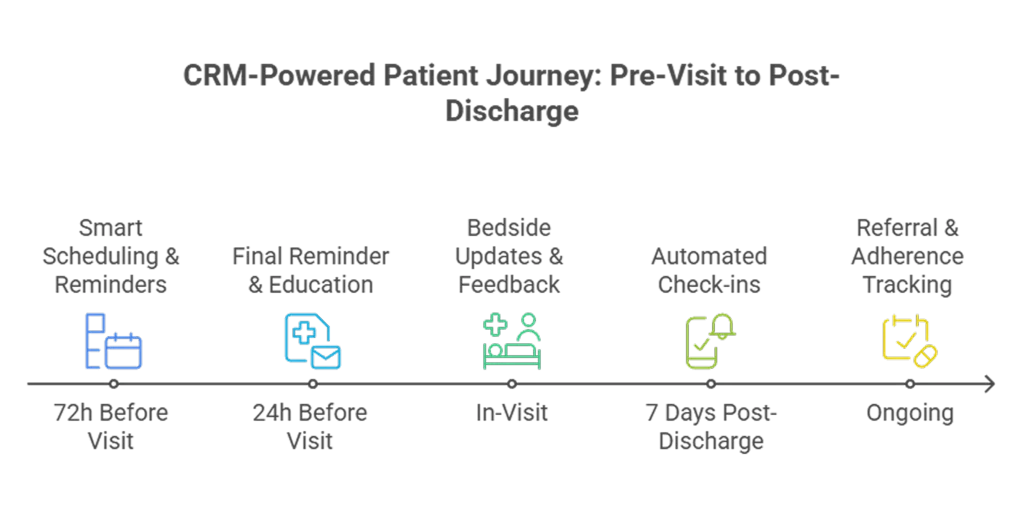
Multi-touch reminder schedules (for example, 72 hours and 24 hours before the visit) adapt when a patient confirms or reschedules. Smart waitlists auto-offer open times as they become available, matched to each patient’s channel preference. “One-tap change” links let patients who cannot make it reschedule without calling. Together, these moves reduce no-shows and late cancellations while preserving clinic capacity.
A CRM can also sequence education in plain language, capture questions ahead of time, and route special needs (such as interpreter or mobility support) to staff. These are practical CRM healthcare benefits that show up as fewer delays and better first impressions.
In-Visit: Communication and Family Engagement
Bedside updates to families, “teach-back” prompts before discharge, and role-based alerts help teams close information gaps. AHRQ’s guidance on partnering with patients and families has shown measurable improvements in safety culture and experience when applied consistently. A CRM operationalizes that playbook.
For hospitals looking to extend real-time communication beyond the facility, WhatsApp patient communication integrated with the CRM enables secure, asynchronous messaging that patients already trust and use daily.
Post-Discharge: Follow-Ups, Referrals, and Medication Adherence
Seven-day check-ins, refill reminders, and referral tracking keep momentum after discharge. WHO and AHRQ emphasize that transitions are fragile: medication discrepancies and communication failures are common. Structured follow-ups are not optional. A CRM makes these steps predictable, documented, and visible to the team responsible for closing the loop.
How Does Hospital CRM Improve HCAHPS Scores?
HCAHPS remains the national, standardized barometer for hospital patient experience. Scores are publicly reported and directly tied to Medicare reimbursement through the Value-Based Purchasing (VBP) program. The hospital’s Customer Relationship Management (CRM) can systematically move the needle on multiple HCAHPS domains.
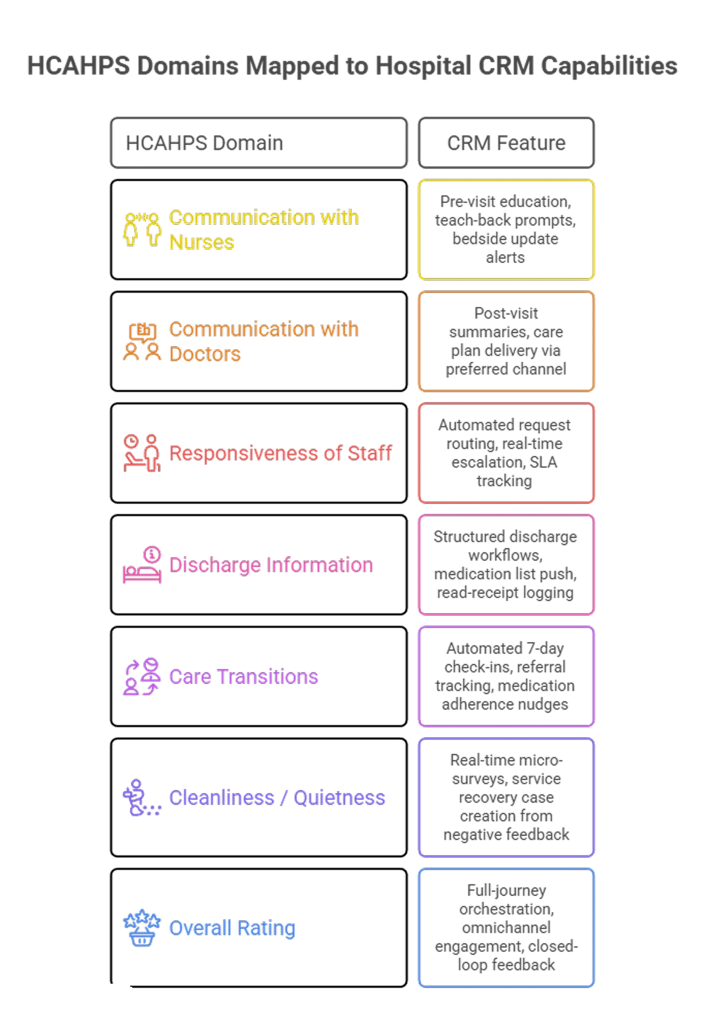
Communication with Nurses and Doctors: The CRM ensures pre-visit prep materials reach patients before they walk in, so clinical conversations start from a shared baseline. Post-visit summaries and teach-back prompts reinforce understanding.
Responsiveness of Hospital Staff: Automated routing of patient requests and real-time escalation alerts reduce response lag. When a patient presses a call button or submits a concern via the portal, the CRM assigns it, tracks it, and timestamps it.
Discharge Information: Structured discharge workflows push medication lists, follow-up appointments, and warning signs through the patient’s preferred channel. The CRM confirms receipt and logs read status.
Care Transitions: Post-discharge follow-up sequences, triggered automatically based on diagnosis and risk score, close the loop on referrals, medications, and home care instructions.
Hospitals investing in CRM-driven patient engagement are already seeing returns. Learn more about the future of AI in hospital CRM and how predictive analytics are being layered on top of these workflows.
How Do You Integrate Hospital CRM with EHR Using FHIR and HL7?
Interoperability standards such as HL7 and FHIR (Fast Healthcare Interoperability Resources) enable data to move safely between systems. FHIR defines resources and formats so apps, portals, and contact centers can share the same core data without brittle, one-off interfaces.
In practice, integration works through event-driven triggers. When a clinical event fires in the EHR (a new appointment, a lab result, a discharge order), the CRM receives a FHIR notification, evaluates the patient’s communication preferences and consent status, and fires the appropriate workflow. This is not a nightly batch export. It is a real-time, bidirectional data flow.
Key integration touchpoints include: appointment scheduling (ADT messages via HL7 or FHIR Encounter resources), lab result availability (FHIR DiagnosticReport), discharge events (FHIR Encounter status change), and referral orders (FHIR ServiceRequest). Each touchpoint triggers a specific CRM workflow: reminders, result notifications, discharge instructions, or referral follow-ups.
The goal is a single patient record that spans clinical and engagement data. No duplicate entry, no stale information, and no manual handoffs between systems.
How Does Service Recovery Work in a Hospital CRM?
Closed-loop service recovery, acknowledging concerns, solving them, and confirming satisfaction, turns detractors into advocates. Routing and Service Level Agreements (SLAs) matter: when a low score or negative comment arrives, your CRM should create a case, assign ownership, and track resolution to protect HCAHPS domains (communication, responsiveness, discharge information, cleanliness, and more).
The workflow typically follows four steps. First, Detect: real-time micro-surveys and NPS prompts surface issues while the patient is still in the facility or within the first 48 hours post-discharge. Second, Route: the CRM assigns the case to the right department or individual based on issue type, severity, and location. Third, Resolve: the assigned owner acknowledges the concern, documents the action taken, and communicates the resolution back to the patient. Fourth, Close: the system logs the outcome, updates HCAHPS-linked dashboards, and triggers a satisfaction confirmation.
Hospitals that treat service recovery as a structured, CRM-managed process see measurably fewer negative HCAHPS responses. Patients who receive a timely acknowledgment and resolution are far less likely to rate the hospital negatively.
What Metrics Should a Hospital CRM Dashboard Track?
Dashboards must show interventions and results in the same view: reminders sent mapped to attendance delta, education sent mapped to prep completion, and recovery cases opened mapped to HCAHPS movement. That is CRM patient management with accountability.
Core metrics to track include: time to next available appointment and waitlist fill rates; HCAHPS top-box scores by domain alongside response rates to micro-surveys; patient portal and app monthly active users with completion of pre-visit tasks; service recovery throughput covering time to acknowledge and time to resolve; post-discharge follow-up completion and time to callback; referral turnaround from received to attended; and medication adherence prompts opened versus acted on.
Go beyond vanity metrics. Establish baselines and control cohorts before turning on a program. Use A/B testing for message timing, channel, and copy to continuously optimize. Systematic reviews show portals can improve patient knowledge and efficiency, but clinical endpoints are mixed without active engagement, so measure the operational steps that drive outcomes.
Compliance and Data Privacy in Hospital CRM
Modern, HIPAA-compliant CRMs enable secure texting of patient privacy and information, but this requires strict adherence to security rules, robust consent management, and audit trails. Prefer platforms that make “minimum necessary” the default, surface consent state at the moment of send, and log every access. That is how you turn policy into practice and maintain trust in patient relationship management.
An AI-powered hospital CRM with built-in compliance guardrails automates consent tracking, encrypts data at rest and in transit, and generates audit-ready reports for regulatory reviews.
Conclusion:
It is time to treat patient communications and service recovery as core clinical infrastructure. With the right hospital CRM, hospitals can make every touchpoint simpler and safer, align programs to national measures, and build trust at scale.
Start with targeted reminders and discharge follow-ups. Wire in feedback with SLAs. Keep expanding the playbook. The result is a smoother journey, stronger patient engagement, and a system that learns from every interaction.
Book a hospital CRM demo to see how Quad One’s AI-powered CRM connects scheduling, follow-ups, feedback loops, and HCAHPS measurement into one engagement engine.
In today’s healthcare landscape, patient privacy and regulatory compliance are paramount. As hospitals and healthcare providers increasingly adopt digital technologies, the responsibility to protect sensitive patient data grows exponentially. Hospital CRM systems sit at the intersection of operational efficiency and data security: they centralise patient data, streamline communication, and manage engagement workflows, but they also become a primary custodian of Protected Health Information (PHI).
A hospital CRM that cannot demonstrate AES-256 encryption, role-based access control (RBAC), comprehensive audit trails, and automated HIPAA compliance checks is a liability, not an asset. This guide serves as an AI healthcare compliance regulatory guide, explaining the security architecture that separates compliant CRM platforms from the rest, covering HIPAA and GDPR requirements in detail, and walking through real-world deployments where hospitals achieved zero breaches and measurable cost reductions.
Security Architecture at a Glance
A HIPAA-compliant hospital CRM delivers: AES-256 encryption for data at rest and TLS 1.2+ for data in transit; role-based access controls limiting PHI visibility to authorised personnel only; immutable audit trails logging every access, modification, and export; automated compliance checks against HIPAA, GDPR, and state-level regulations; consent management surfacing patient preferences at the point of communication; and a signed Business Associate Agreement (BAA) with the CRM vendor. One US provider achieved zero data breaches and a 25% reduction in administrative compliance costs after deploying a HIPAA-compliant CRM with these capabilities.
How Does Hospital CRM Protect Patient Privacy?
Healthcare CRM systems are specifically designed to help hospitals and clinics manage patient relationships efficiently. But their importance goes beyond operational efficiency. They are vital tools in ensuring patient privacy. Here are the core privacy-protection mechanisms built into a compliant hospital CRM.
AES-256 Data Encryption
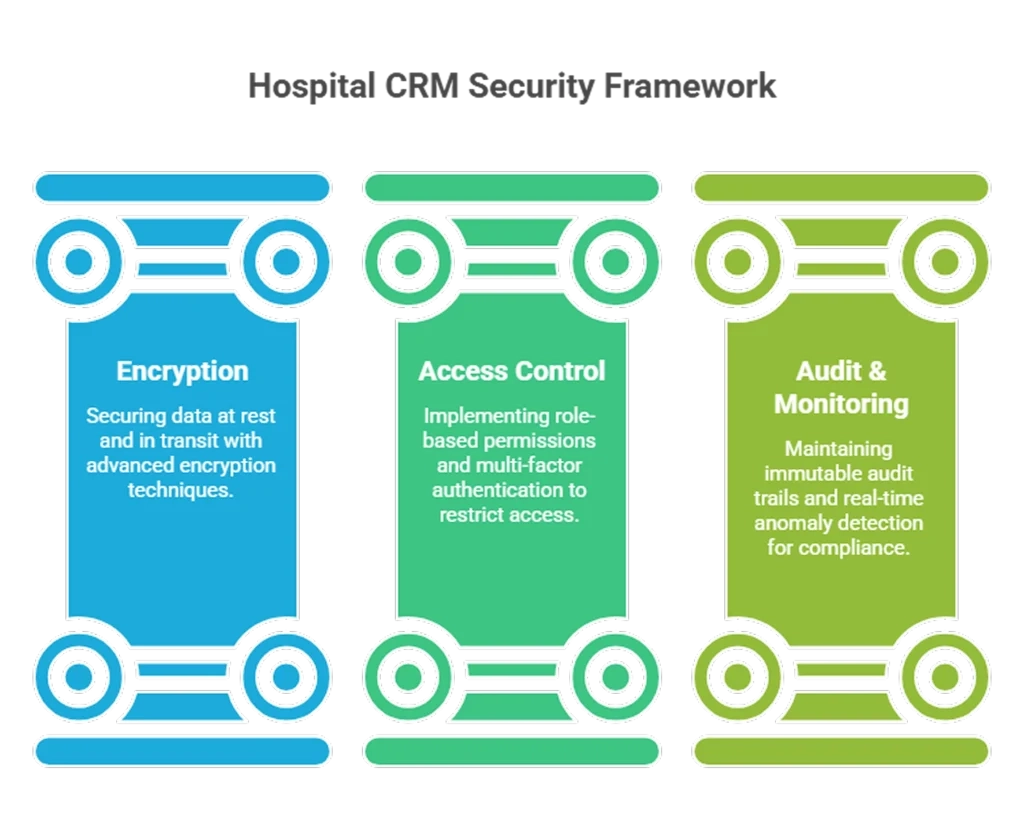
One of the most critical features of a healthcare CRM for patient privacy is data encryption. Healthcare CRMs use AES-256 encryption to safeguard sensitive patient information. This encryption ensures that data remains unreadable during transmission (in transit, protected by TLS 1.2 or higher) and when stored on servers (at rest). Even if unauthorised individuals gain access to the data, they cannot decipher it without the correct decryption keys. AES-256 is the industry gold standard, providing a level of protection that is practically unbreakable with current computing technology.
Role-Based Access Control (RBAC)
RBAC ensures that only authorised personnel can view or modify specific categories of patient data. A front-desk coordinator sees scheduling information but not clinical notes. A billing specialist accesses financial records but not diagnostic reports. A physician sees the full clinical record. This “minimum necessary” principle, mandated by HIPAA, is enforced at the system level, not left to individual judgment.
RBAC also extends to communication: a CRM should surface consent status at the moment of send, preventing a staff member from messaging a patient who has opted out of a specific channel. This mechanism not only supports patient privacy but also facilitates better compliance with HIPAA requirements.
Strong access controls are also foundational to improving patient experience through hospital CRM — patients who trust that their data is secure are more willing to engage with digital communication channels, complete pre-visit forms, and share feedback.
Audit Trails and Continuous Monitoring
Hospital CRM maintains audit trails that record every access or modification made to patient data. These logs capture who accessed the data, when they did it, what changes were made, and from which device or location. Continuous monitoring helps identify unauthorised access, misuse, or potential threats, ensuring that healthcare organisations can respond quickly to resolve security issues.
Audit logs also provide a transparent and traceable record for compliance purposes. Hospitals can produce these logs during HIPAA audits to demonstrate adherence to regulatory standards and protect against fines. Under the 2026 HIPAA rule updates, the Office for Civil Rights (OCR) will focus on verifiable technical implementation rather than policy documentation, making functioning audit systems more important than ever.
How Does Hospital CRM Ensure HIPAA Compliance?
The Health Insurance Portability and Accountability Act (HIPAA) is one of the most stringent regulations governing patient privacy and data protection in the US. A hospital CRM ensures HIPAA compliance through several integrated mechanisms.
Automated Compliance Checks
A HIPAA-compliant CRM automates the verification of regulatory requirements across every patient interaction. Before a message is sent, the system checks consent status, communication channel permissions, and PHI exposure levels. Non-compliant actions are blocked before they happen, not flagged after the fact. This is automated policy enforcement, not manual checklist management.
Business Associate Agreement (BAA)
Any CRM vendor that stores, processes, or transmits PHI on behalf of a hospital must sign a BAA. This legally binding agreement defines the vendor’s responsibilities for safeguarding patient data, specifies permissible uses and disclosures, sets breach notification timelines, and establishes subcontractor obligations. Without a signed BAA, the CRM platform is not legally permitted to handle PHI. This is a non-negotiable threshold in vendor selection.
HIPAA Privacy, Security, and Breach Notification Rules
The CRM must address all three HIPAA rule categories. The Privacy Rule governs how PHI can be used and disclosed, requiring minimum-necessary data access and patient rights management. The Security Rule mandates technical safeguards (encryption, authentication, audit controls, integrity controls, transmission security) for electronic PHI. The Breach Notification Rule requires timely notification to affected individuals and HHS if a breach occurs, making detection and incident response capabilities essential CRM features.
2026 HIPAA Rule Updates
Starting in late 2026, all healthcare organisations must implement verifiable technical safeguards rather than simply documenting policies. Encryption at rest and in transit becomes explicitly mandatory (not just “addressable”). MFA becomes required for all systems accessing ePHI. Annual penetration testing, biannual vulnerability scans, and quarterly backup restoration tests are now required compliance activities. Hospital CRMs must be built to meet these enhanced standards.
How Does Hospital CRM Ensure GDPR Compliance?
For hospitals operating in or serving patients from the European Union, the General Data Protection Regulation (GDPR) adds a second compliance layer on top of HIPAA. A GDPR-compliant hospital CRM must address explicit consent management, data subject rights (access, rectification, erasure, portability), data processing agreements with all third-party processors, privacy-by-design architecture, and Data Protection Impact Assessments (DPIAs) for high-risk processing activities.
In practice, this means the CRM must capture and store explicit patient consent for each category of data processing, allow patients to view, export, or request deletion of their data through self-service or staff-assisted workflows, and maintain records of processing activities that demonstrate compliance to supervisory authorities.
For hospitals using messaging platforms to communicate with patients, GDPR and HIPAA compliance extend to every channel. See how patient data privacy in WhatsApp-based healthcare communication is managed through end-to-end encryption, consent tracking, and dual-layer protection systems.
How Does Hospital CRM Improve Efficiency While Maintaining Security?
Security and operational efficiency are not trade-offs in a well-architected hospital CRM. They are mutually reinforcing.
Automated appointment scheduling and reminders operate through encrypted channels, reducing missed appointments while maintaining HIPAA-compliant communication. The CRM checks consent and channel preference before every send.
Centralised patient data means clinical, scheduling, billing, and communication records are stored in a single, encrypted repository with RBAC. Staff spend less time searching across disconnected systems, and every access is logged.
EHR integration via FHIR APIs ensures that data flows securely between clinical and engagement systems without manual re-entry or unencrypted exports. The CRM reads from and writes to the EHR through standardised, auditable interfaces.
AI-powered anomaly detection identifies unusual patterns in patient data access (after-hours queries, bulk exports, access from unfamiliar devices) and alerts IT teams in real time. Machine learning algorithms continuously learn from past security events, improving the system’s ability to predict and prevent future threats.
Telehealth integration extends these security controls to remote consultations. Hospital CRM systems ensure that voice, video, and messaging interactions remain encrypted and compliant whether the patient is in the facility, at home, or on a mobile device.
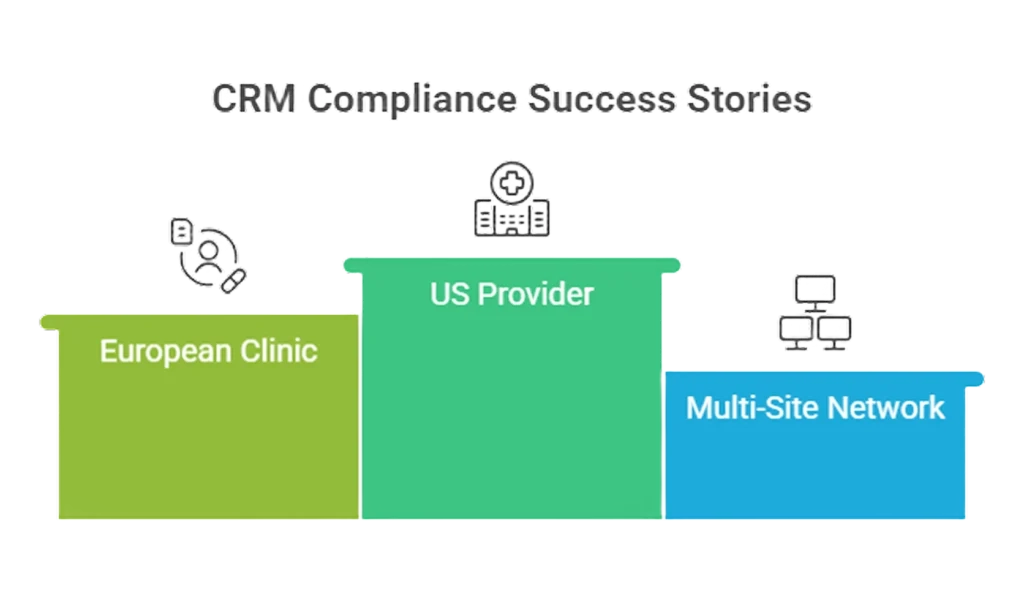
What Do Real-World Hospital CRM Compliance Deployments Look Like?
US Healthcare Provider: Zero Breaches, 25% Cost Reduction
A US-based healthcare provider implemented a HIPAA-compliant CRM to centralise patient data, streamline communication, and automate compliance checks. The CRM’s automated compliance engine ensured that every patient interaction adhered to HIPAA standards without manual review. Audit trails provided full transparency during regulatory audits. The result: zero data breaches since deployment and a 25% reduction in administrative compliance costs.
European Clinic: GDPR-Compliant Patient Data Management
A European clinic integrated a healthcare CRM for patient privacy, ensuring compliance with GDPR. The CRM allowed the clinic to store patient data securely while managing explicit consent forms for data processing. Patients could access, modify, or request deletion of their data through a self-service portal. The clinic passed its GDPR supervisory authority audit with no findings.
Multi-Site Hospital Network: Telehealth + CRM Security
Hospital CRM is increasingly integrated with telemedicine platforms and remote monitoring technologies, enabling healthcare providers to securely manage patient interactions and data remotely. One multi-site network deployed a CRM that maintained HIPAA-compliant security across in-person, phone, and virtual consultation channels. Encrypted communication, consent verification, and audit logging operated identically regardless of modality.
How Does Hospital CRM Manage Patient Consent?
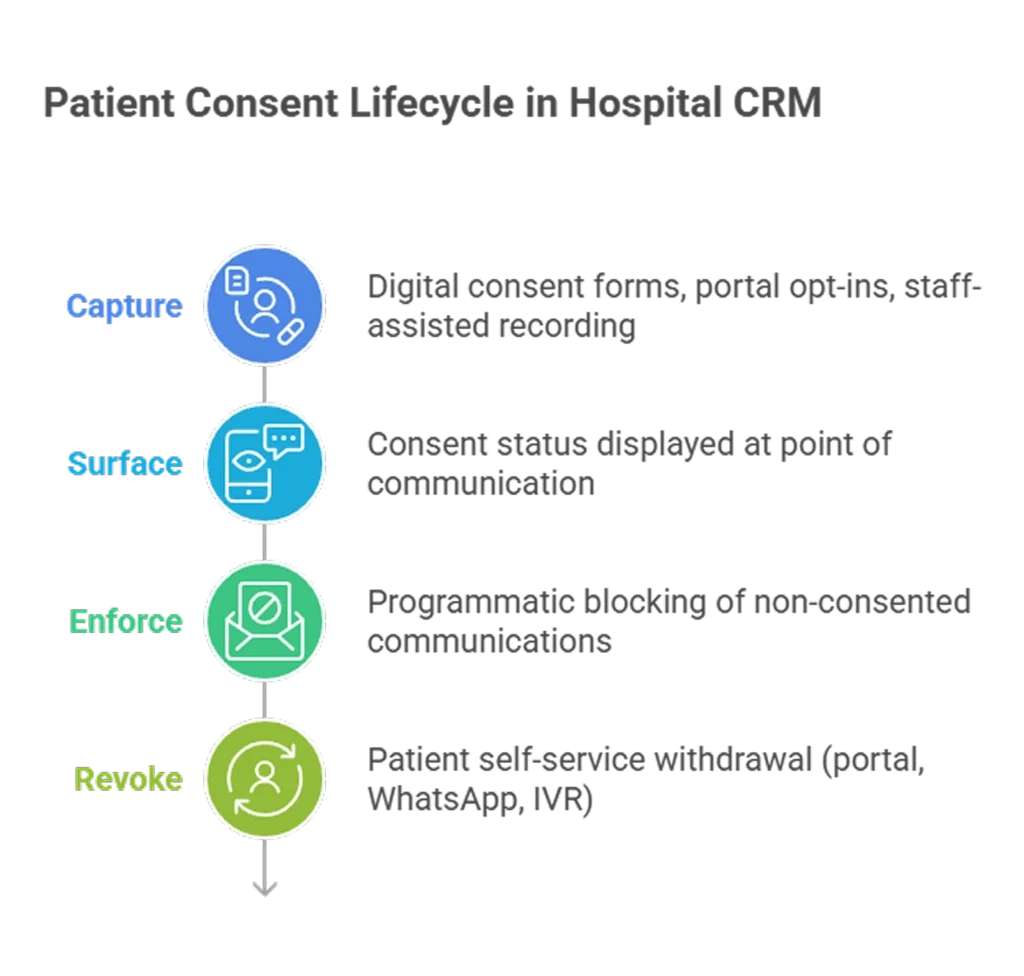
Patient consent management is a critical but often under-architected capability. A compliant hospital CRM must capture, store, surface, and enforce consent preferences across every communication channel and data processing activity.
Capture: The CRM records explicit consent for each category (appointment reminders, marketing, research, data sharing) through digital forms, patient portal opt-ins, or staff-assisted workflows. Consent records include timestamp, method, and scope.
Surface: At the moment a staff member or automated workflow initiates a patient communication, the CRM displays the patient’s current consent status for that specific channel and purpose. Non-consented sends are blocked.
Enforce: The system enforces consent rules programmatically. A patient who has consented to SMS appointment reminders but opted out of email marketing will only receive SMS, and only for appointment purposes. No manual override is permitted without a documented clinical justification.
Revoke: Patients can withdraw consent at any time through self-service (patient portal, WhatsApp, IVR) or staff-assisted channels. Revocation takes effect immediately and is logged in the audit trail.
The Future of AI in Hospital CRM: Privacy and Compliance
As technology continues to evolve, healthcare CRM will remain a cornerstone of secure, compliant patient care. Emerging developments include:
AI-powered threat detection that moves beyond rule-based monitoring to behavioural analysis, identifying insider threats and sophisticated attack patterns before a breach occurs.
Zero-trust architecture where every access request is verified regardless of network location, replacing perimeter-based security with continuous authentication.
Privacy-enhancing technologies (PETs) such as differential privacy and federated learning allow AI models to train on patient data without exposing individual records.
Automated regulatory tracking that updates compliance rules in real time as HIPAA, GDPR, and state-level regulations evolve, ensuring the CRM never falls behind current requirements.
Conclusion
By integrating advanced security features such as AES-256 encryption, role-based access controls, immutable audit trails, and automated compliance checks, healthcare organisations can safeguard sensitive patient data while enhancing operational efficiency. For hospital administrators, compliance officers, and IT managers, investing in a robust, HIPAA-compliant CRM is no longer optional. It is a necessity to protect both patient data and the organisation’s reputation.
As reimbursement models shift, AI in CRM is driving better value-based care outcomes by aligning secure patient engagement with measurable clinical and financial performance.
Explore Quad One’s AI-powered Hospital CRM — purpose-built for healthcare with HIPAA compliance, AES-256 encryption, RBAC, and audit-ready reporting out of the box.
Book a compliance demo to see how the security architecture works in practice
