
Prompts play a critical role in healthcare because they directly shape how AI interprets information and delivers results. In a field where accuracy, clarity, and safety are essential, even small changes in how a prompt is written can significantly influence the outcome.
A well-designed prompt helps AI generate precise and clinically relevant responses whether it’s summarizing patient records, drafting medical documentation, or supporting decision-making. By clearly defining the context, intent, and expected format, prompts reduce ambiguity and ensure the output aligns with clinical needs.and it changes everything.
Prompt Engineering in Healthcare: Best Practices, Strategies and Trends
With technology becoming a bigger part of healthcare, giving clear instructions to systems is more important than ever. Prompt engineering helps doctors and staff get accurate answers for tasks like diagnosis, documentation, and patient data. By framing the right questions, healthcare professionals can reduce errors, save time, and make better-informed decisions.
It also supports smoother workflows by simplifying complex processes and improving communication between teams and digital tools. As new trends and tools continue to evolve, adopting effective prompt strategies can help healthcare organizations stay efficient, deliver more personalized care, and achieve better patient outcomes.
The Rise of AI in Healthcare: A New Frontier
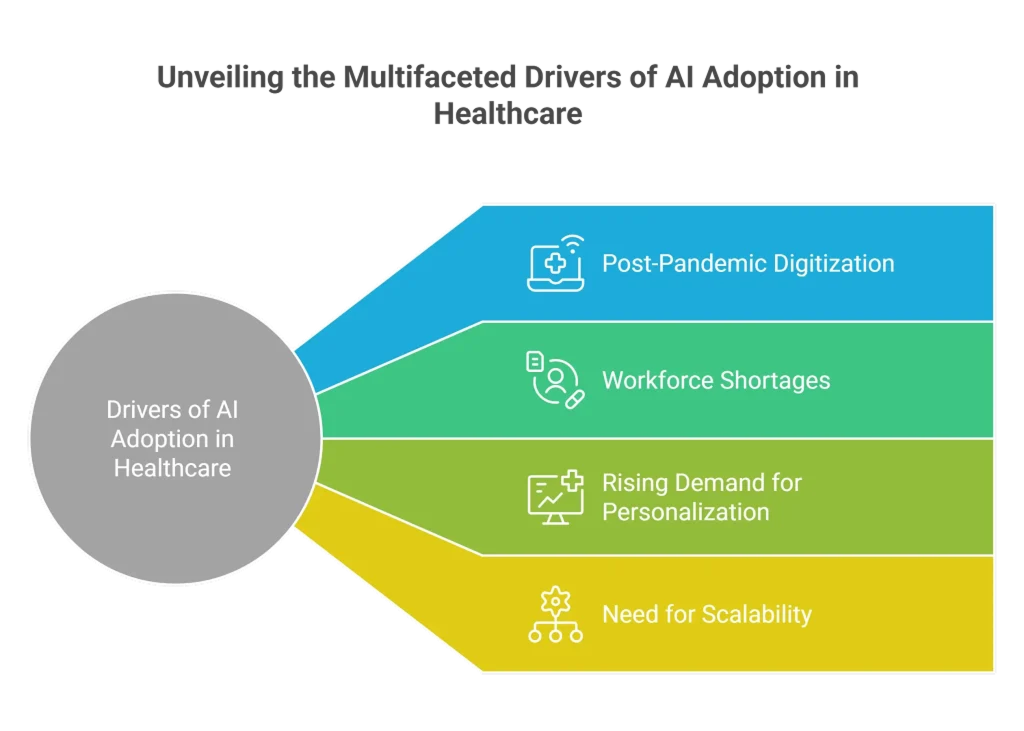
Healthcare is stepping into a new era where artificial intelligence is not just supporting care — it’s actively shaping how it’s delivered, reflecting AI in healthcare 2026 top trends that are redefining clinical practice and operations.
This shift marks a new frontier, where technology and human expertise work side by side to improve outcomes, reduce inefficiencies, and create more personalized patient experiences. As AI continues to evolve, it’s redefining the boundaries of what healthcare systems can achieve.
How Generative AI is Transforming Modern Care
In recent years, healthcare has witnessed rapid advancements in artificial intelligence. Models like GPT-4 have demonstrated near expert-level performance in medical assessments, while Med-PaLM 2 has shown high accuracy in clinical reasoning tasks. These developments highlight how natural language processing is reshaping both clinical and operational aspects of healthcare, with generative AI in healthcare explored across diagnostics, documentation, and patient communication.
From enabling personalized treatment approaches to improving operational efficiency, AI is helping providers make more informed and timely decisions. Today, healthcare organizations are integrating large language models (LLMs) into workflows to summarize electronic health records (EHRs), assist with patient communication, and generate clinical documentation all guided by well-crafted prompts.
What Is Prompt Engineering in Healthcare?
Prompt engineering in healthcare refers to the practice of designing structured and precise instructions that guide AI systems to produce accurate, safe, and clinically relevant outputs.
In a high-stakes environment like healthcare, prompts act as a control layer between human intent and AI response. Whether it’s generating diagnostic suggestions, drafting reports, or assisting in patient interactions, the quality of the prompt directly influences the reliability of the outcome.
Well-designed prompts help reduce ambiguity, ensure alignment with clinical standards, and support compliance with regulatory requirements. As AI adoption grows, prompt engineering is becoming essential for integrating AI safely and effectively into healthcare workflows.
Clinical Applications of Prompt Engineering
Prompt engineering is increasingly important in clinical settings as it helps healthcare professionals use AI tools more effectively. By giving clear instructions, clinicians can get accurate information for diagnosis, patient data analysis, and treatment planning. This makes AI more reliable and helps improve overall efficiency in healthcare workflows.
Enhancing Diagnostic Accuracy with Medical AI Prompts
Structured prompts can significantly improve clinical decision support. For instance:
A 60-year-old male with chest pain and shortness of breath. Provide possible causes, recommended diagnostic tests, and an initial treatment plan.
Such prompts enable AI to generate organized and clinically relevant outputs, supporting faster and more accurate decision-making.
Domain-Specific Prompting in Clinical Practice
Specialty-focused prompts enhance precision and usability:
- Oncology: Analyze imaging for tumor size, location, and stage
- Mental Health: Guide patient conversations with empathetic follow-ups
- Cardiology: Interpret ECGs and flag abnormalities
Tailored prompts align AI outputs with clinical workflows, improving both efficiency and accuracy.
Personalized Treatment Planning
AI models can assist in developing treatment plans by incorporating patient history, co-morbidities, and clinical guidelines.
Prompt Format:
[Patient Summary] + [Clinical Goal] + [Guideline Constraints]
This approach ensures recommendations remain evidence-based while allowing clinicians to validate and refine outputs.
Streamlining Administrative Workflows with Prompt Engineering
Managing administrative tasks in healthcare can often be time-consuming and complex. Prompt engineering helps simplify these processes by guiding AI systems with clear instructions, making tasks like documentation, scheduling, and data handling faster and more accurate. This not only improves efficiency but also reduces workload, allowing healthcare staff to focus more on patient care.
Automating Clinical Documentation
Prompt-driven AI can reduce administrative workload by:
- Drafting clinical notes and summaries
- Generating referral letters
- Preparing discharge instructions
Prompt Format:
[Task] + [Document Type] + [Formatting Requirements]
Enhancing Operational Efficiency
Enhancing operational efficiency in healthcare focuses on improving how daily tasks and processes are managed. By optimizing workflows, reducing delays, and using technology effectively, organizations can save time, lower costs, and improve accuracy. This ultimately helps deliver faster, more reliable care and a better experience for both patients and staff.
AI prompts are also used for:
- AI is transforming medical coding and billing support
- Prior authorization documentation
- Insurance communication
Standardized prompts improve turnaround time and ensure consistency across administrative processes.
Improving Patient Experience with Healthcare Chatbots
Integration strategies in hospitals aim to link different systems, technologies, and workflows for smoother operations. By bringing together tools like health records, AI, and clinical processes, hospitals can improve communication, minimize errors, and deliver better patient care. This leads to a more organized and efficient healthcare system.
Prompt Design in Virtual Health Assistants
AI-powered chatbots rely on structured prompts to:
- Conduct symptom checks
- Provide pre-visit guidance
- Offer follow-up care instructions
Empathetic and Clear Communication
Prompts that guide AI to respond in simple, patient-friendly language improve trust and engagement. They help translate complex medical information into understandable insights, enhancing the overall patient experience.
Integration Strategies for Hospitals
Hospitals often use many different systems that don’t always work well together. Integration strategies help connect these tools and processes so information flows smoothly across departments. This improves coordination, reduces errors, and makes overall hospital operations more efficient while supporting better patient care.
Embedding in EHR Systems
AI tools are increasingly integrated into platforms like EHR systems, where prompts are automatically triggered based on clinical context, enabling seamless workflow integration.
Training Clinical Teams
Educating healthcare professionals on prompt usage ensures:
- More effective AI interaction
- Reduced errors
- Consistent and reliable outputs
What Are Key Best Practices for AI Prompt Engineering in Healthcare?
Strong prompt engineering is key to generating accurate, safe, and context-relevant outputs from AI in healthcare. Following best practices helps organizations improve reliability, stay compliant, and support better clinical decisions while reducing potential risks.
Prompts Must Be Specific
Clear and detailed prompts lead to more accurate and relevant outputs. Vague instructions often result in incomplete or unreliable responses.
Provide Relevant Context With Follow-Up Prompts
Including patient history, clinical background, and additional clarifications helps AI generate more precise insights. Follow-up prompts can refine and improve responses further.
Give Examples of Desired Outputs
Providing sample outputs or formats helps guide AI in structuring responses correctly, ensuring consistency and usability in clinical settings.
Challenges and Ethical Considerations
The growing use of AI in healthcare brings both new possibilities and important challenges that cannot be overlooked. Factors such as accuracy, data privacy, bias, and overdependence on technology must be carefully addressed to protect patient safety and maintain trust. Ensuring responsible use through clear guidelines, ethical practices, and human oversight is essential for effective implementation.
Managing AI Hallucinations and Clinical Risk
AI systems may generate incorrect yet plausible responses. Structured prompts and human oversight are essential to minimize such risks.
Ensuring Data Privacy
Sensitive patient data must be protected through secure systems, de-identification, and compliance with healthcare regulations.
Responsible AI Use
Healthcare organizations must prioritize transparency, informed consent, and human involvement in critical decisions.
Future Outlook: Scaling Prompt Engineering in Healthcare
As AI evolves, prompt engineering will play a central role in enabling. As these systems grow more interconnected, using a model context protocol for AI communication will help agents share context reliably across tools and workflows.
- Multimodal AI applications (text, images, and data integration)
- Advanced clinical decision support
- Personalized and scalable patient care
Investing in prompt libraries, governance frameworks, and continuous optimization will be key to unlocking long-term value.
Conclusion
Prompt engineering is rapidly becoming a foundational element in healthcare AI. By structuring inputs effectively and refining them over time, organizations can ensure AI delivers accurate, safe, and meaningful outcomes.
From improving diagnostics and automating documentation to enhancing patient engagement, prompt engineering is shaping a smarter, more efficient, and patient-centric healthcare ecosystem.
Advance Healthcare with Intelligent Innovation
Explore how prompt engineering and AI are shaping the future of healthcare delivery. Stay informed with expert-led insights and practical strategies. Subscribe for updates.
| Quick Answer: AI chatbots improve patient engagement in healthcare by providing 24/7 automated support across triage, appointment scheduling, medication reminders, and post-discharge follow-up. Unlike rule-based bots, AI-powered chatbots use natural language processing to understand context, personalise responses, and integrate with EHR systems — reducing administrative burden while improving patient satisfaction and care continuity. |
AI chatbots in healthcare are no longer futuristic. They are a present-day reality reshaping how patients engage with care providers. Unlike basic rule-based bots that follow pre-programmed scripts, AI-powered chatbots can understand context, respond dynamically, and learn over time to improve interactions. These chatbots are embedded in websites, mobile apps, EHR systems, and messaging platforms, and their core purpose is to assist patients with routine tasks and information without the need for live human intervention.
From real-time support and multilingual communication to personalized follow-ups and streamlined scheduling, these digital assistants are helping hospitals and health systems meet rising patient expectations while easing the load on clinical staff. Systems like UCHealth, Mount Sinai Health System, and Singapore General Hospital are already running live deployments that demonstrate measurable impact.
Chatbots on messaging platforms like WhatsApp extend this reach further. Quad One’s AI WhatsApp Bot lets patients schedule appointments, retrieve reports, and get support in their own language all within a single WhatsApp conversation, with no app downloads required, illustrating how AI WhatsApp bots are changing patient access by removing friction from the first point of contact.
What Is the Difference Between a Rule-Based and AI-Powered Healthcare Chatbot?
Not all healthcare chatbots are created equal. Understanding the distinction between rule-based and AI-powered chatbots is critical for healthcare leaders evaluating solutions.
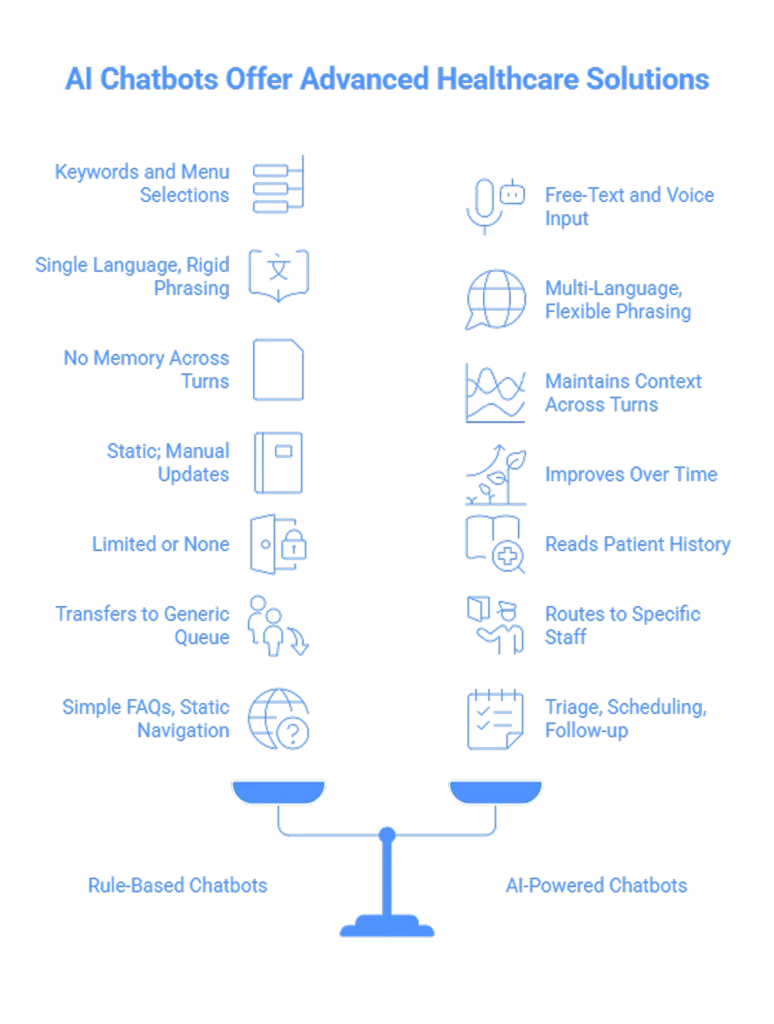
Rule-based chatbots follow pre-programmed decision trees. They respond to specific keywords or menu selections with fixed answers. They work well for simple, predictable tasks (FAQs, basic navigation) but break down when patients phrase questions in unexpected ways. They cannot learn, cannot handle ambiguity, and cannot maintain context across a multi-turn conversation.
AI-powered chatbots use natural language processing (NLP) and machine learning to understand intent, extract entities, and generate contextual responses. They handle free-text input, support multiple languages, improve over time as they process more interactions, and can escalate to human staff when they detect clinical complexity or patient distress. Modern AI chatbots can also integrate with EHR and CRM systems to personalise responses based on a patient’s history.
The practical difference: a rule-based bot might fail if a patient types “I need to see someone about my knee” instead of selecting “Orthopedics” from a menu. An AI chatbot understands the intent, maps it to the right department, checks provider availability, and offers to book.
How Do AI Chatbots Improve Patient Engagement? Core Use Cases
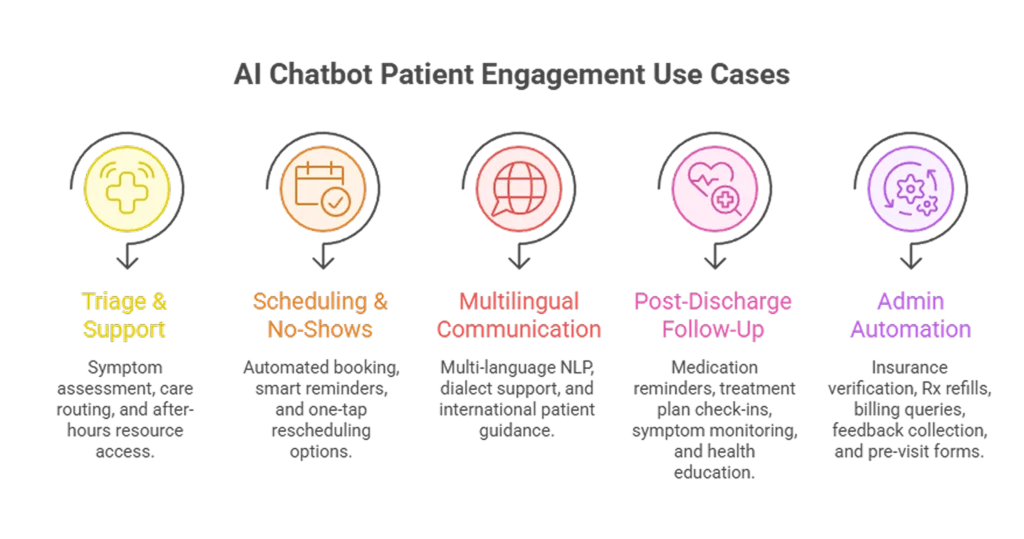
1. 24/7 Instant Support and Triage
One of the most immediate advantages of AI chatbots is their ability to provide instant, around-the-clock assistance. Patients do not have to wait for business hours or navigate phone trees. A chatbot can answer questions about symptoms, medications, billing, insurance, or hospital services at any hour. For clinical queries, AI chatbots can perform preliminary triage, assessing symptom severity and routing patients to the appropriate care level (self-care guidance, GP appointment, urgent care, or emergency).
Mount Sinai Health System deployed an AI chatbot that handles basic triage questions and connects patients to relevant resources after hours. This reduces the burden on call centres and builds patient trust by ensuring help is always available.
2. Appointment Scheduling and No-Show Reduction
AI chatbots automate appointment bookings, send smart reminders, and help reschedule when needed. UCHealth in Colorado uses a chatbot named Livi, which integrates with their My Health Connection patient portal to streamline the booking process and reduce no-show rates. Livi helps patients schedule appointments, check symptoms, and access educational resources, handling thousands of interactions per month.
3. Multilingual Patient Communication
In regions with linguistic diversity, language is a barrier to effective healthcare. AI chatbots support multiple languages and dialects, making information accessible to a wider audience. Bumrungrad International Hospital in Thailand uses AI chatbots that offer multilingual support for international patients, guiding them through registration, pre-consultation FAQs, and post-visit summaries. This level of inclusivity ensures no patient is left behind due to language limitations.
4. Post-Discharge Follow-Up and Education
Engaging patients does not end when they leave the clinic. AI chatbots can follow up on treatment plans, send personalised medication reminders, and check on symptoms. These ongoing interactions also serve as a powerful tool for education, delivering easy-to-understand information that empowers patients to take charge of their health. Singapore General Hospital employs AI chatbots in its telehealth services to screen symptoms and route patients to appropriate departments before consultations, improving response time and reducing clinical staff workload.
5. Administrative Automation
Beyond patient-facing interactions, chatbots automate high-volume administrative tasks: insurance verification, prescription refill requests, billing queries, feedback collection, and pre-visit form completion. Each of these tasks, when handled manually, consumes staff time and introduces error risk. A single AI chatbot can handle thousands of these interactions simultaneously, freeing clinical and front-desk staff for higher-value work.
Real-World Case Studies: UCHealth, Mount Sinai, and Singapore General Hospital
UCHealth (Colorado, USA)
UCHealth implemented Livi, an AI chatbot integrated with its My Health Connection portal. Originally built to help patients find locations and providers, Livi quickly evolved as patients began asking about test results, doctor messages, and health-specific questions. The chatbot now handles thousands of interactions per month, improving patient access to information and reducing administrative overhead for staff. Livi bridges the gap between patients and their digital health tools, helping them accomplish tasks faster using systems that already exist.
When chatbot interactions feed into an AI hospital CRM, every patient query becomes actionable data: appointment requests route to scheduling, symptom reports trigger care workflows, and satisfaction signals inform service recovery.
Mount Sinai Health System (New York, USA)
Mount Sinai launched a chatbot capable of answering general medical questions, guiding users to care pathways, and connecting them to telemedicine options during non-clinical hours. The chatbot handles basic triage questions and routes patients to the right resources, reducing the burden on after-hours call centres and building patient trust through always-available support.
Singapore General Hospital
Singapore General Hospital employs AI chatbots in its telehealth services to screen symptoms and route patients to appropriate departments before consultations. This method helps prioritise care needs, reduce wait times, and ensure patients are well-prepared before meeting a provider either virtually or in person. The integration of triage chatbots with telehealth has been particularly effective in managing specialist referral workflows.
These case studies share a common pattern: AI chatbots succeed when they are integrated with existing clinical systems (EHR, scheduling engines, patient portals) and when they are designed to escalate to human staff at the right moment, not replace them.
How AI Healthcare Chatbots Work: Technical Architecture
A healthcare AI chatbot operates through a pipeline that converts patient input into an actionable response:
Natural Language Processing (NLP) parses the patient’s input (text or voice-to-text), identifies intent (book, ask, cancel, report symptom), and extracts entities (provider name, date, symptom type, medication name).
Dialogue management maintains conversation context across multiple turns. If a patient asks about a test result and then says “what does that mean?”, the system understands “that” refers to the previously discussed result, not a new query.
Back-end integration connects via APIs (including FHIR where applicable) to EHR systems, scheduling engines, billing platforms, and knowledge bases. The chatbot reads real-time data (appointment availability, lab results, insurance status) and writes actions back (book appointment, create refill request, log triage outcome).
Safety and escalation logic ensure the chatbot knows its limits. When it detects clinical urgency (chest pain, suicidal ideation), ambiguity it cannot resolve, or patient frustration, it transfers to a human agent with the full conversation context attached. No cold handoff.
HIPAA compliance requires end-to-end encryption, patient identity verification before PHI access, audit logging of every interaction, and secure data storage. The chatbot vendor must sign a Business Associate Agreement (BAA).
The Future of AI Chatbots in Patient Engagement
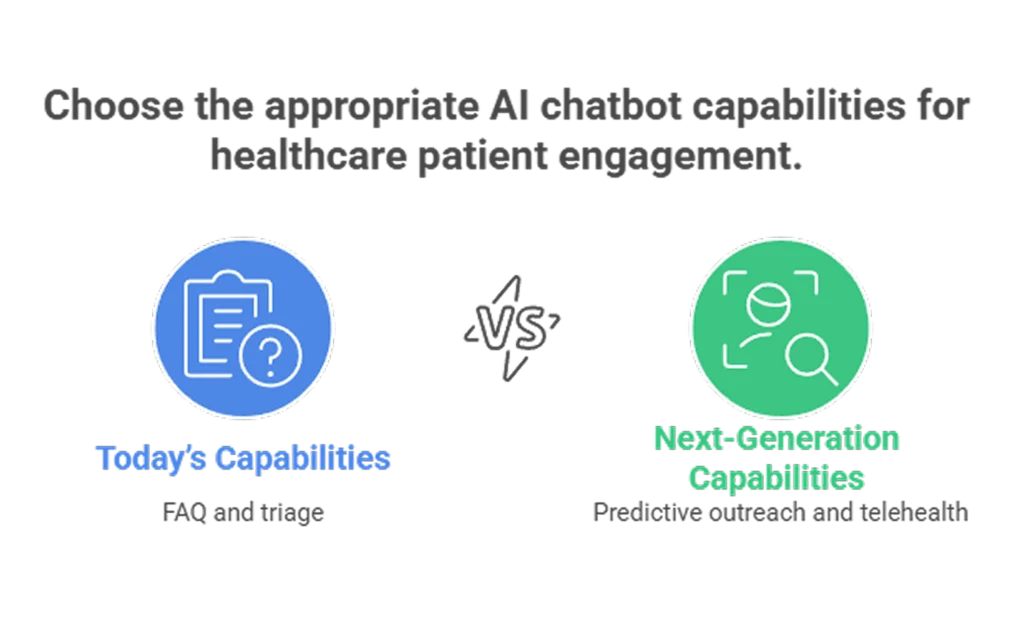
As technology continues to evolve, AI chatbots will become more predictive, more integrated, and more essential to delivering high-quality, patient-centred care. Key developments on the horizon include:
Predictive engagement. Chatbots that proactively reach out to patients based on risk signals (overdue screenings, medication non-adherence patterns, post-surgical recovery milestones) rather than waiting for patients to initiate contact.
Deeper EHR integration. Chatbots that access real-time clinical data to offer personalised, context-aware responses. A patient asking “When is my next appointment?” gets a specific answer, not a generic “Please call our office.”
Telehealth convergence. Chatbots that triage symptoms and smoothly hand off to a live video consultation when clinical assessment is needed. Explore Quad One’s AI telemedicine solution to see how chat-to-video workflows are already operational.
Ambient listening and documentation. AI chatbots that listen to patient-provider conversations (with consent), generate structured clinical notes, and push them to the EHR, reducing documentation burden on clinicians.
Emotional intelligence. Sentiment analysis that detects patient anxiety, confusion, or frustration and adjusts conversational tone, pace, and complexity in real time.
Conclusion
AI chatbots in healthcare are not a single-use tool. They are a versatile patient engagement layer that operates across the full care continuum: from pre-visit triage and scheduling through in-visit support to post-discharge follow-up and chronic disease management. What makes them powerful is their versatility. They are equally effective in busy US health systems like UCHealth as they are in forward-thinking Asian providers like Singapore General Hospital.
For healthcare leaders looking to enhance engagement, improve operational efficiency, and support patient-centered care, the time to invest in AI chatbot solutions is now.
Explore Quad One’s AI Chatbot Solutions. Book a demo to see how our AI-powered chatbot and WhatsApp bot connect triage, scheduling, follow-up, and patient engagement in one platform.
External References
Chatbots in Health Care
