
The UAE’s healthcare sector is stepping into a new era, one shaped by digital innovation, intelligent systems, and deeply connected care. By 2026, the shift toward AI-driven ecosystems, integrated health platforms, and patient-centric models is no longer just emerging; it’s becoming the backbone of how modern healthcare operates. Technologies like telemedicine, remote monitoring, predictive analytics, and automated workflows are helping providers make faster decisions, improve diagnostic accuracy, and deliver more seamless patient experiences.
At the heart of this transformation are healthcare IT companies ranging from global leaders to specialised regional players, each contributing in different ways. Some bring large-scale system integration and enterprise expertise, while others focus on cloud-native development, localised compliance, or cost-effective innovation. Together, they are enabling healthcare providers to move beyond reactive treatment models toward proactive, continuous, and data-driven care.
The Rise of Digital Healthcare in the UAE (2026)
The UAE has rapidly positioned itself as a global leader in healthcare technology, driven by strong government initiatives, growing private investment, and widespread digital adoption. By 2026, the healthcare ecosystem is expected to be highly integrated and intelligent, where seamless data exchange, virtual care, and personalised treatment journeys become the norm rather than the exception.
Healthcare applications, in particular, have evolved far beyond basic functionality. Today, they act as intelligent platforms combining teleconsultation, remote monitoring, AI-assisted diagnostics, and personalised care pathways. This shift is making healthcare more accessible, efficient, and proactive, ultimately improving outcomes while enhancing patient engagement.
Leading Healthcare IT Companies in the UAE
A diverse mix of global enterprises and regional specialists is powering this transformation. Each company brings its own strengths, depending on the scale, complexity, and specific needs of healthcare organisations.
Quad One Technologies
Quad One Technologies is steadily emerging as a strong player in the UAE’s healthcare IT space, known for its AI-first approach and automation-led solutions. With over two decades of experience, the company focuses on building intelligent, future-ready systems by blending artificial intelligence, machine learning, and data analytics with real-world clinical workflows.
- AI-first approach with 20+ years of industry experience
- Combines AI, machine learning, and data analytics with clinical workflows
- Focuses on proactive, data-driven care delivery
- Streamlines patient engagement and operational efficiency
- Optimizes clinical data management for healthcare providers
- Positioned as a long-term digital health partner in the UAE
Build AI-powered healthcare IT solutions with Quad One Technologies.
Zymr
Zymr stands out for its expertise in cloud-native development and digital health product engineering. The company builds scalable, secure, and compliant healthcare solutions, including patient engagement platforms, clinical data systems, and AI-powered applications.
- Specialises in cloud-native healthcare product engineering
- Builds scalable, secure, and compliance-ready solutions
- Covers patient engagement platforms and clinical data systems
- Delivers AI-powered applications tailored to health tech needs
- Flexible delivery model suited for both startups and established providers
- Strong fit for organisations scaling across the GCC market
Cerner (Oracle Health)
Now part of Oracle Health, Cerner has a well-established presence in the UAE healthcare ecosystem. Its Millennium platform is widely adopted across large hospital networks and government health systems.
- Part of Oracle Health with a strong UAE market presence
- The Millennium platform was widely adopted across hospitals and government systems
- Robust EHR capabilities with high interoperability standards
- Integrates with national health exchanges — Malaffi and Nabidh
- Supports data standardisation across multi-facility organisations
- Best suited for large-scale healthcare networks requiring enterprise-grade solutions
Intelhealth
IntelHealth differentiates itself with a strong regional focus. Its healthcare information systems and clinical software are designed specifically for Gulf environments, featuring Arabic-first interfaces and built-in compliance with UAE regulations.
- Deep regional focus tailored for Gulf healthcare environments
- Arabic-first interfaces designed for local usability
- Built-in compliance with UAE regulatory standards
- Strong familiarity with DHA and HAAD requirements
- Ideal for organisations seeking locally adapted, not generic, solutions
- Reliable choice for navigating UAE-specific healthcare regulations
Accenture
Accenture brings a powerful mix of strategic consulting and large-scale execution capabilities. In the UAE, it plays a key role in driving digital transformation across both public and private healthcare sectors.
- Combines strategic consulting with large-scale digital execution
- Active across both public and private UAE healthcare sectors
- Expertise in AI integration, cloud migration, and system modernisation
- Capable of managing complex, long-term transformation programs
- Delivers end-to-end solutions from vision to implementation
- Best suited for organisations undertaking enterprise-wide transformation
Warba Systems
Warba Systems offers a strong regional advantage with solutions designed specifically for the Gulf healthcare landscape. Its platforms support Arabic-language workflows, local insurance integration, and regulatory compliance.
- Purpose-built solutions for the Gulf healthcare market
- Supports Arabic-language workflows and local insurance integration
- Ensures regulatory compliance across the UAE health authorities
- Hands-on understanding of regional operational challenges
- Practical and dependable partner for localised healthcare needs
- Strong track record with providers that value regional expertise
Cognizant
Cognizant has expanded its healthcare footprint in the Middle East with a comprehensive suite of services spanning payer systems, provider operations, analytics, and revenue cycle management.
- Comprehensive healthcare services across payer and provider systems
- Expertise in analytics and revenue cycle management
- Manages complex, multi-stakeholder healthcare environments
- Expanding Middle East presence with proven delivery capabilities
- Valuable for large hospital groups and insurance providers
- Suited for end-to-end digital transformation at scale
Philips Healthcare
Philips Healthcare occupies a unique space by bridging medical hardware and digital health software. Its offerings include imaging systems, patient monitoring, and AI-powered diagnostics, all connected within a unified ecosystem.
- Uniquely bridges medical hardware and digital health software
- Offers imaging systems, patient monitoring, and AI diagnostics
- All solutions operate within a connected, unified ecosystem
- Enables seamless integration between clinical equipment and IT
- AI-powered tools enhance diagnostic accuracy and clinical decision-making
- Preferred partner for hospitals seeking hardware-software integration
Innowise
Innowise is gaining traction for its strong engineering capabilities and cost-effective delivery models. The company specialises in custom healthcare application development, including telemedicine platforms, analytics tools, and AI-driven solutions.
- Strong engineering capabilities with cost-effective delivery
- Specialises in custom healthcare application development
- Builds telemedicine platforms, analytics tools, and AI solutions
- Ideal for startups and mid-sized healthcare organisations
- Delivers high-quality solutions without enterprise-level costs
- Growing reputation for flexible and scalable development models
Wipro
Wipro has established itself as a reliable partner for large-scale healthcare IT initiatives in the UAE. Its expertise spans hospital information systems, data management, and digital transformation programs.
- Reliable partner for large-scale healthcare IT in the UAE
- Expertise across hospital information systems and data management
- Proven digital transformation methodologies and frameworks
- Backed by strong regional teams with local market knowledge
- Solid choice for government entities and large healthcare providers
- Experienced in managing complex, multi-year IT implementation programs
AI and automation are also playing a critical role. From assisting in diagnostics to automating administrative workflows, these technologies are reducing the burden on healthcare professionals while improving efficiency. This allows clinicians to spend more time focusing on what truly matters: patient care.
Ultimately, healthcare is shifting from a reactive model to a continuous, personalised care journey where prevention, early detection, and long-term engagement take priority.
How to Choose the Right Healthcare IT Services Company
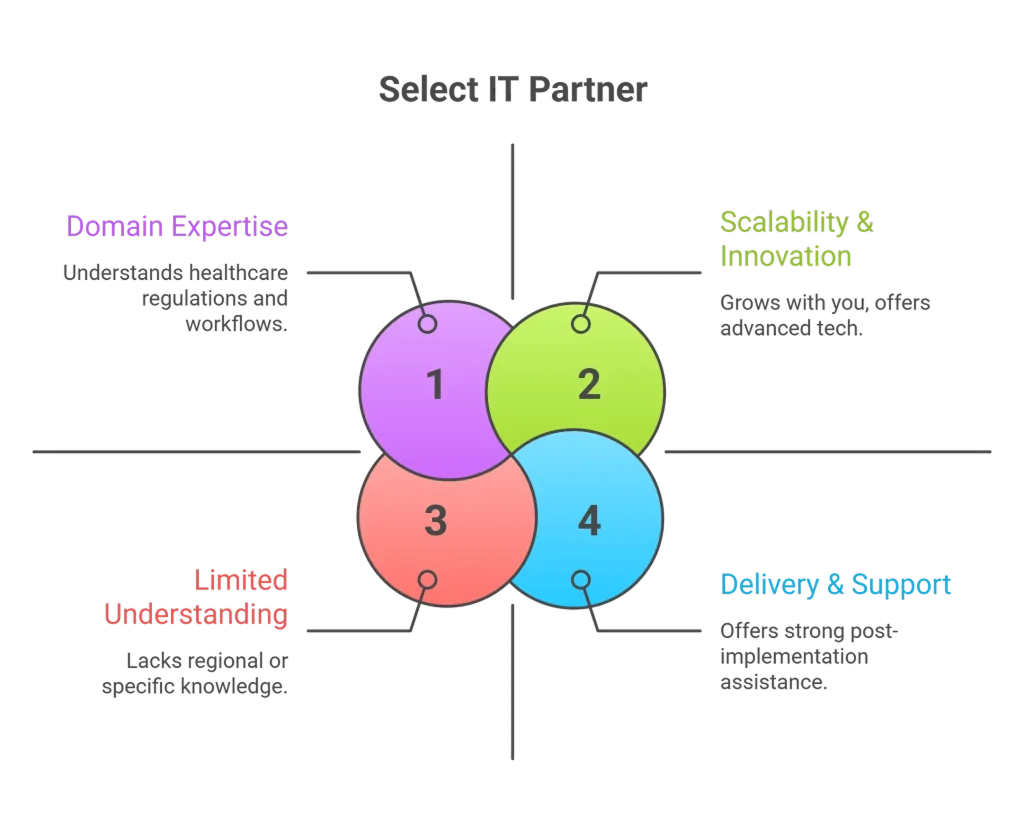
Choosing the right healthcare IT partner is a strategic decision that directly impacts efficiency, scalability, and patient outcomes.
Start by evaluating domain expertise. Healthcare is highly regulated, so it’s essential to work with a partner that understands compliance requirements, data security, and clinical workflows.
Next, consider scalability and technology capabilities. Your partner should be able to grow with your organisation while offering expertise in areas like cloud computing, AI, data analytics, and system integration.
Regional understanding is especially important in the UAE. Companies familiar with local regulations, insurance systems, and language requirements can significantly reduce implementation challenges.
It’s also important to assess their delivery model and support structure. Strong post-implementation support, transparent communication, and a collaborative approach are key indicators of a reliable partner.
Finally, think beyond cost. The goal is to find a partner that offers long-term value, a balance of quality, innovation, and cost-efficiency.
What’s Actually Shifting in Care Delivery
Healthcare IT companies are fundamentally transforming how care is delivered, experienced, and managed. What was once a fragmented, reactive system is now becoming proactive, connected, and patient-centric.
One of the biggest shifts is the move toward real-time, data-driven care. With integrated systems and health information exchanges, providers can access patient records instantly, enabling faster and more accurate decision-making. This reduces delays, minimises errors, and improves overall care quality.
Another major transformation is the rise of virtual care and remote monitoring. Patients no longer need to rely solely on in-person visits. Through teleconsultations, wearable integrations, and mobile health apps, care can now happen anytime and anywhere, improving accessibility, especially for chronic disease management.
AI and automation are also playing a crucial role. From AI-powered diagnostics to automated administrative workflows, healthcare IT is reducing the burden on medical staff while improving efficiency. This allows healthcare professionals to focus more on patient care rather than operational tasks.
Ultimately, these advancements are shifting healthcare from a reactive model to a continuous, personalised care journey, where prevention, early detection, and long-term engagement take centre stage.
Post-implementation support, clear communication, and a collaborative approach are key indicators of a strong partnership.
Finally, align on budget and long-term value. The cheapest option isn’t always the best. Focus on partners who offer a balance of quality, innovation, and cost-efficiency.
Why Partnering with a Top Healthcare IT Services Company Matters
Working with a leading healthcare IT company is no longer just about technology; it’s about strategy and long-term growth.
Top-tier providers bring proven frameworks, deep industry expertise, and access to advanced technologies that can accelerate digital transformation. Instead of building everything from scratch, organisations can leverage established platforms and best practices.
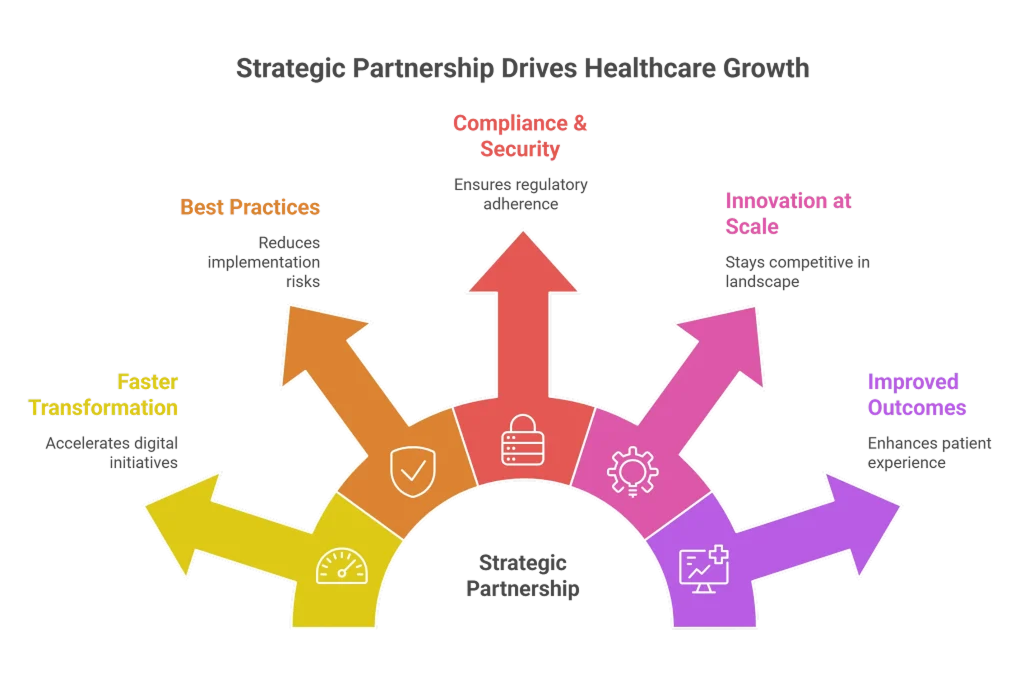
Strategic Impact:
Partnering with a leading healthcare IT company is not just a technical choice. It’s a strategic decision that shapes long-term growth and innovation.
Faster Digital Transformation:
Top-tier providers bring proven frameworks, industry expertise, and advanced technologies, helping organisations accelerate transformation without building from scratch.
Access to Best Practices:
Established platforms and tested methodologies reduce risk and ensure smoother implementation.
Regulatory Compliance & Security:
Experienced partners ensure adherence to healthcare regulations and strong data security, protecting sensitive patient information and maintaining trust.
Innovation at Scale:
Continuous investment in AI, predictive analytics, and interoperability helps organisations stay competitive in a rapidly evolving landscape.
Improved Patient Outcomes:
The right partner enables faster diagnoses, personalised treatment plans, and seamless communication, enhancing overall patient experience and care quality.
Healthcare IT Companies Comparison: Core Strengths & Best Fit.
| Company | Best For | Core Strength | Unique Edge |
|---|---|---|---|
| Quad One | AI-driven providers | AI-first healthcare systems | 20+ yrs clinical + AI expertise |
| Zymr | GCC startups | Cloud-native engineering | Fast scaling delivery |
| Cerner | Enterprise hospitals | Deep EHR systems | Malaffi + Nabidh integration |
| Intelhealth | UAE providers | Arabic-first healthcare software | UAE regulation-ready |
| Accenture | Large transformation projects | Strategy + execution | Enterprise consulting depth |
| Warba Systems | Local Gulf rollout | Regional healthcare expertise | Gulf-native workflows |
| Cognizant | Hospitals + insurers | End-to-end healthcare ops | Payer + provider expertise |
| Philips Healthcare | Device-heavy hospitals | Hardware + software integration | Imaging + diagnostics |
| Innowise | Budget-conscious teams | Custom development | Cost-effective engineering |
| Wipro | Government + enterprise | Reliable implementation | Strong regional delivery |
Conclusion
The future of healthcare in the UAE is being built right now, and technology is leading the way. Healthcare IT services companies are at the centre of this transformation, driving a shift toward more connected, efficient, and patient-focused systems. From global technology leaders to specialised regional players, each brings unique strengths that are helping shape a smarter, more integrated healthcare ecosystem.
As healthcare continues to evolve in 2026 and beyond, choosing the right IT partner will become increasingly critical for organisations aiming to stay competitive. Those who invest in the right technologies and partnerships today will be better positioned to deliver smarter care, improve patient outcomes, and meet the rising expectations of modern healthcare consumers.
External references
Top Healthcare Software Development Companies in Dubai
HealthTech SaaS Startups in United Arab Emirates
Prompts play a critical role in healthcare because they directly shape how AI interprets information and delivers results. In a field where accuracy, clarity, and safety are essential, even small changes in how a prompt is written can significantly influence the outcome.
A well-designed prompt helps AI generate precise and clinically relevant responses whether it’s summarizing patient records, drafting medical documentation, or supporting decision-making. By clearly defining the context, intent, and expected format, prompts reduce ambiguity and ensure the output aligns with clinical needs.and it changes everything.
Prompt Engineering in Healthcare: Best Practices, Strategies and Trends
With technology becoming a bigger part of healthcare, giving clear instructions to systems is more important than ever. Prompt engineering helps doctors and staff get accurate answers for tasks like diagnosis, documentation, and patient data. By framing the right questions, healthcare professionals can reduce errors, save time, and make better-informed decisions.
It also supports smoother workflows by simplifying complex processes and improving communication between teams and digital tools. As new trends and tools continue to evolve, adopting effective prompt strategies can help healthcare organizations stay efficient, deliver more personalized care, and achieve better patient outcomes.
The Rise of AI in Healthcare: A New Frontier
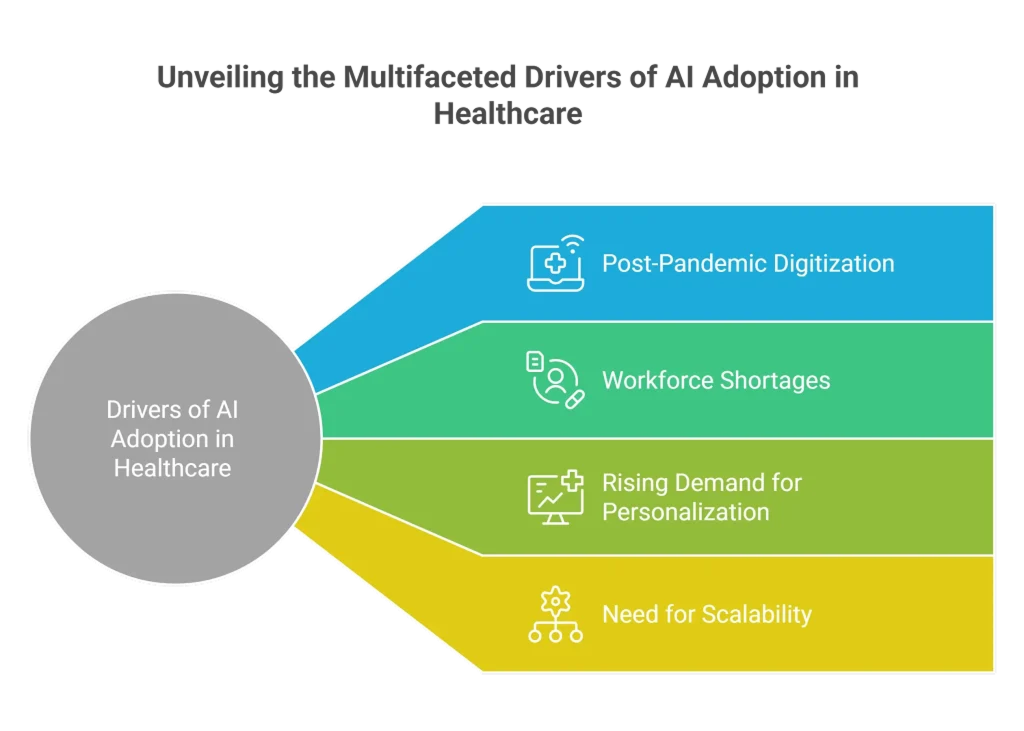
Healthcare is stepping into a new era where artificial intelligence is not just supporting care — it’s actively shaping how it’s delivered, reflecting AI in healthcare 2026 top trends that are redefining clinical practice and operations.
This shift marks a new frontier, where technology and human expertise work side by side to improve outcomes, reduce inefficiencies, and create more personalized patient experiences. As AI continues to evolve, it’s redefining the boundaries of what healthcare systems can achieve.
How Generative AI is Transforming Modern Care
In recent years, healthcare has witnessed rapid advancements in artificial intelligence. Models like GPT-4 have demonstrated near expert-level performance in medical assessments, while Med-PaLM 2 has shown high accuracy in clinical reasoning tasks. These developments highlight how natural language processing is reshaping both clinical and operational aspects of healthcare, with generative AI in healthcare explored across diagnostics, documentation, and patient communication.
From enabling personalized treatment approaches to improving operational efficiency, AI is helping providers make more informed and timely decisions. Today, healthcare organizations are integrating large language models (LLMs) into workflows to summarize electronic health records (EHRs), assist with patient communication, and generate clinical documentation all guided by well-crafted prompts.
What Is Prompt Engineering in Healthcare?
Prompt engineering in healthcare refers to the practice of designing structured and precise instructions that guide AI systems to produce accurate, safe, and clinically relevant outputs.
In a high-stakes environment like healthcare, prompts act as a control layer between human intent and AI response. Whether it’s generating diagnostic suggestions, drafting reports, or assisting in patient interactions, the quality of the prompt directly influences the reliability of the outcome.
Well-designed prompts help reduce ambiguity, ensure alignment with clinical standards, and support compliance with regulatory requirements. As AI adoption grows, prompt engineering is becoming essential for integrating AI safely and effectively into healthcare workflows.
Clinical Applications of Prompt Engineering
Prompt engineering is increasingly important in clinical settings as it helps healthcare professionals use AI tools more effectively. By giving clear instructions, clinicians can get accurate information for diagnosis, patient data analysis, and treatment planning. This makes AI more reliable and helps improve overall efficiency in healthcare workflows.
Enhancing Diagnostic Accuracy with Medical AI Prompts
Structured prompts can significantly improve clinical decision support. For instance:
A 60-year-old male with chest pain and shortness of breath. Provide possible causes, recommended diagnostic tests, and an initial treatment plan.
Such prompts enable AI to generate organized and clinically relevant outputs, supporting faster and more accurate decision-making.
Domain-Specific Prompting in Clinical Practice
Specialty-focused prompts enhance precision and usability:
- Oncology: Analyze imaging for tumor size, location, and stage
- Mental Health: Guide patient conversations with empathetic follow-ups
- Cardiology: Interpret ECGs and flag abnormalities
Tailored prompts align AI outputs with clinical workflows, improving both efficiency and accuracy.
Personalized Treatment Planning
AI models can assist in developing treatment plans by incorporating patient history, co-morbidities, and clinical guidelines.
Prompt Format:
[Patient Summary] + [Clinical Goal] + [Guideline Constraints]
This approach ensures recommendations remain evidence-based while allowing clinicians to validate and refine outputs.
Streamlining Administrative Workflows with Prompt Engineering
Managing administrative tasks in healthcare can often be time-consuming and complex. Prompt engineering helps simplify these processes by guiding AI systems with clear instructions, making tasks like documentation, scheduling, and data handling faster and more accurate. This not only improves efficiency but also reduces workload, allowing healthcare staff to focus more on patient care.
Automating Clinical Documentation
Prompt-driven AI can reduce administrative workload by:
- Drafting clinical notes and summaries
- Generating referral letters
- Preparing discharge instructions
Prompt Format:
[Task] + [Document Type] + [Formatting Requirements]
Enhancing Operational Efficiency
Enhancing operational efficiency in healthcare focuses on improving how daily tasks and processes are managed. By optimizing workflows, reducing delays, and using technology effectively, organizations can save time, lower costs, and improve accuracy. This ultimately helps deliver faster, more reliable care and a better experience for both patients and staff.
AI prompts are also used for:
- AI is transforming medical coding and billing support
- Prior authorization documentation
- Insurance communication
Standardized prompts improve turnaround time and ensure consistency across administrative processes.
Improving Patient Experience with Healthcare Chatbots
Integration strategies in hospitals aim to link different systems, technologies, and workflows for smoother operations. By bringing together tools like health records, AI, and clinical processes, hospitals can improve communication, minimize errors, and deliver better patient care. This leads to a more organized and efficient healthcare system.
Prompt Design in Virtual Health Assistants
AI-powered chatbots rely on structured prompts to:
- Conduct symptom checks
- Provide pre-visit guidance
- Offer follow-up care instructions
Empathetic and Clear Communication
Prompts that guide AI to respond in simple, patient-friendly language improve trust and engagement. They help translate complex medical information into understandable insights, enhancing the overall patient experience.
Integration Strategies for Hospitals
Hospitals often use many different systems that don’t always work well together. Integration strategies help connect these tools and processes so information flows smoothly across departments. This improves coordination, reduces errors, and makes overall hospital operations more efficient while supporting better patient care.
Embedding in EHR Systems
AI tools are increasingly integrated into platforms like EHR systems, where prompts are automatically triggered based on clinical context, enabling seamless workflow integration.
Training Clinical Teams
Educating healthcare professionals on prompt usage ensures:
- More effective AI interaction
- Reduced errors
- Consistent and reliable outputs
What Are Key Best Practices for AI Prompt Engineering in Healthcare?
Strong prompt engineering is key to generating accurate, safe, and context-relevant outputs from AI in healthcare. Following best practices helps organizations improve reliability, stay compliant, and support better clinical decisions while reducing potential risks.
Prompts Must Be Specific
Clear and detailed prompts lead to more accurate and relevant outputs. Vague instructions often result in incomplete or unreliable responses.
Provide Relevant Context With Follow-Up Prompts
Including patient history, clinical background, and additional clarifications helps AI generate more precise insights. Follow-up prompts can refine and improve responses further.
Give Examples of Desired Outputs
Providing sample outputs or formats helps guide AI in structuring responses correctly, ensuring consistency and usability in clinical settings.
Challenges and Ethical Considerations
The growing use of AI in healthcare brings both new possibilities and important challenges that cannot be overlooked. Factors such as accuracy, data privacy, bias, and overdependence on technology must be carefully addressed to protect patient safety and maintain trust. Ensuring responsible use through clear guidelines, ethical practices, and human oversight is essential for effective implementation.
Managing AI Hallucinations and Clinical Risk
AI systems may generate incorrect yet plausible responses. Structured prompts and human oversight are essential to minimize such risks.
Ensuring Data Privacy
Sensitive patient data must be protected through secure systems, de-identification, and compliance with healthcare regulations.
Responsible AI Use
Healthcare organizations must prioritize transparency, informed consent, and human involvement in critical decisions.
Future Outlook: Scaling Prompt Engineering in Healthcare
As AI evolves, prompt engineering will play a central role in enabling. As these systems grow more interconnected, using a model context protocol for AI communication will help agents share context reliably across tools and workflows.
- Multimodal AI applications (text, images, and data integration)
- Advanced clinical decision support
- Personalized and scalable patient care
Investing in prompt libraries, governance frameworks, and continuous optimization will be key to unlocking long-term value.
Conclusion
Prompt engineering is rapidly becoming a foundational element in healthcare AI. By structuring inputs effectively and refining them over time, organizations can ensure AI delivers accurate, safe, and meaningful outcomes.
From improving diagnostics and automating documentation to enhancing patient engagement, prompt engineering is shaping a smarter, more efficient, and patient-centric healthcare ecosystem.
Advance Healthcare with Intelligent Innovation
Explore how prompt engineering and AI are shaping the future of healthcare delivery. Stay informed with expert-led insights and practical strategies. Subscribe for updates.
