
As we advance through 2025, the healthcare industry is witnessing a paradigm shift. What once began as an emergency response to the global pandemic has now matured into a sophisticated, scalable component of modern care. The future of telemedicine is no longer theoretical, it is foundational to how hospitals, clinicians, and patients interact. With evolving policies, emerging technologies, and changing patient expectations, telemedicine in healthcare is being redefined by innovation and integration.
For hospital administrators, clinical innovation leaders, and health IT professionals, the ability to adapt and lead this transformation is more than a strategic advantage, it is a healthcare imperative.
Telemedicine’s Strategic Role in Healthcare Systems
From Peripheral Tool to Core Strategy
Telemedicine has evolved beyond convenience; it is now a critical enabler of operational efficiency, patient engagement, and care continuity. Hospitals and healthcare systems are embedding virtual consultations into routine clinical workflows, supported by cloud-based healthcare solutions that offer secure, compliant, and scalable infrastructure.
Health systems are now adopting telehealth platforms that not only connect patients to clinicians but also support population health management, triage automation, and digital-first care pathways.
Policy Shifts and Regulatory Enablement
Legislation and regulatory frameworks in the US, Europe, and Asia have extended support for virtual care through 2025. The U.S. has allowed Medicare beneficiaries to access telehealth from home with continued reimbursement support. In Europe, national telemedicine strategies have enabled cross-border consultations, while India’s eSanjeevani has surpassed 340 million free online consultations, highlighting the public health potential of remote healthcare delivery.
Key Technologies Driving Virtual Healthcare in 2025
Artificial Intelligence in Telemedicine
The integration of artificial intelligence in telemedicine is enhancing diagnostic accuracy, streamlining documentation, and enabling intelligent triage systems. AI-powered decision support tools are embedded into EHR systems, allowing physicians to make faster and more informed decisions.
Ambient clinical intelligence, such as AI scribes and virtual assistants, has improved the telemedicine user experience for both providers and patients. These tools reduce cognitive load and allow clinicians to focus more on personalized patient care.
Virtual Healthcare Innovations
Innovations in virtual healthcare have made care delivery more accessible, interactive, and patient-centered. From digital therapeutics to app-based rehabilitation programs, virtual-first care is being embraced across specialties. Mobile-first solutions offer intuitive user interfaces and are designed to support multilingual, culturally adaptive care experiences.
Additionally, secure telemedicine software now includes advanced encryption, multi-factor authentication, and consent capture to ensure compliance with HIPAA, GDPR, and other global standards.
Remote Patient Monitoring (RPM)
Remote patient monitoring is bridging the gap between episodic care and continuous health management. Wearables and connected devices such as smartwatches, ECG monitors, and glucose sensors transmit real-time health data to providers. This data is seamlessly integrated into care dashboards, enabling proactive interventions and early detection of complications.
RPM has shown significant impact in chronic care management, particularly for conditions like hypertension, COPD, and diabetes. Many health systems have established virtual chronic care clinics that use telehealth as the front door to ongoing support.
Clinical Integration and the Rise of Hybrid Care
Embedding Telemedicine in Clinical Workflows
The modern healthcare environment no longer distinguishes between virtual and in-person care; they are interconnected. Whether through automated scheduling for post-operative follow-ups or virtual triage before emergency visits, patient-centered virtual care is becoming the standard.
Telehealth is also expanding in specialties like oncology, psychiatry, and dermatology. For example, tele-dermatology is enabling faster diagnosis and treatment planning through high-resolution image submissions and asynchronous specialist consultations.
Hospital-at-Home and Acute Telehealth Services
In 2025, hospital-at-home models are gaining traction, supported by integrated telehealth and RPM technologies. Patients with moderate acute conditions can now receive hospital-level care at home with regular virtual check-ins and on-demand escalation protocols.
These models are particularly impactful in reducing readmission rates, improving patient satisfaction, and lowering operational costs. They are also supported by cloud-based remote monitoring solutions and virtual nursing platforms.
Global Innovation Outlook
Regional Trends in the U.S., Europe, and Asia
In the U.S., the continuation of telehealth reimbursement policies has led to greater institutional investments in virtual infrastructure. Europe, with its centralized health systems, is focusing on telehealth for aging populations and rural outreach. Asia is witnessing a technology-led transformation with platforms like Ping An Good Doctor and widespread mobile health adoption in rural India and Southeast Asia.
Each region contributes unique innovations, from AI-integrated public systems to private virtual hospitals, building a diverse but converging future for telemedicine.
Future-Forward Technologies
Predictive Analytics and Proactive Care
Predictive analytics is becoming a cornerstone in proactive healthcare delivery. By analyzing data from wearables, EHRs, and historical patient records, healthcare systems can anticipate complications and intervene early. This capability enables tailored interventions and more efficient chronic disease management.
5G and Low-Latency Telehealth
The rollout of 5G technology is transforming virtual care by enabling ultra-low latency connections. This facilitates high-resolution video consultations, real-time diagnostics, and remote robotic surgeries, especially in rural and bandwidth-challenged areas.
Real-Time Transcription and Clinical Documentation
AI-powered transcription tools now provide real-time clinical documentation during telehealth visits. This reduces administrative burdens, enhances accuracy, and allows clinicians to maintain eye contact and engagement with patients during virtual encounters.
API-First and Interoperable Platforms
Modern telehealth platforms are increasingly adopting API-first architectures, making it easier to integrate with third-party apps, health information exchanges, and EHR systems. Interoperability ensures seamless data exchange, supports care continuity, and enhances the overall telemedicine user experience.
Emerging innovations include AR/VR for physical therapy and pain management, real-time language translation for global consultations, and blockchain-enabled health data security. The evolution of telehealth platforms into complete care ecosystems is now a dominant theme.
Moreover, virtual second opinions and international teleconsultations are expanding the reach of clinical expertise beyond geographical boundaries.
Expert Perspectives: Challenges and Opportunities
Healthcare leaders agree that the success of virtual care depends on three pillars: integration, equity, and usability. While adoption rates are high, ensuring inclusivity for older adults, rural populations, and those with limited digital literacy remains a challenge.
To address this, health systems are providing telehealth navigators, multilingual support tools, and offline patient education. Telemedicine user experience is being reimagined not just for tech-savvy users, but for all demographic segments.
Conclusion: Leading with Innovation, Compassion, and Intelligence
The future of telemedicine is shaping a new era in global healthcare, one that is more inclusive, intelligent, and accessible. As telemedicine in healthcare becomes the default for many services, it is imperative for decision-makers to invest in agile platforms, patient-centric design, and sustainable policy models.
By aligning virtual healthcare innovations, remote patient monitoring, and artificial intelligence in telemedicine with operational strategies, healthcare leaders can build resilient, connected, and compassionate care ecosystems.
The healthcare organizations that succeed in 2025 and beyond will be those that see telemedicine not as an adjunct but as a core pillar of care.
Explore AI-Powered Telemedicine with Quad One
Quad One’s AI Telemedicine Solution streamlines patient care with intelligent appointment scheduling, automated triage, and real-time reporting—all within a secure and scalable digital infrastructure.
Transform Healthcare Access, One Virtual Visit at a Time
Stay ahead with expert insights and proven strategies on how AI-powered telemedicine is reshaping patient engagement, scheduling, and care delivery. Subscribe now!
Healthcare systems worldwide are under immense pressure to balance operational efficiency with delivering timely, personalised patient care. Traditional appointment booking methods, primarily phone calls or online forms, often lead to bottlenecks, staff overload, and suboptimal patient experiences. Voice assistants for healthcare appointment booking are changing this dynamic. These AI-powered systems use natural language processing (NLP) to engage with patients via speech, allowing them to schedule, modify, or cancel appointments using simple spoken commands, 24/7, without call queues.
| Quick Answer : Voice assistants streamline healthcare appointment booking by using natural language processing (NLP) to let patients schedule, modify, or cancel appointments via voice commands — 24/7, without call queues. Integrated with EHR and CRM systems via FHIR APIs, they reduce no-show rates by up to 72%, cut cost-per-booking from $8–15 to $1–3, and free staff from up to 38% of administrative scheduling workload. |
Voice scheduling is one component of a broader AI in healthcare transformation that is reshaping how hospitals operate, engage patients, and deliver care.
Whether it is booking a consultation with a general practitioner or scheduling a specialised diagnostic test, voice assistants offer real-time interaction that mirrors human-like conversation. This guide covers how they work, how they integrate with hospital systems, what results leading hospitals are seeing, and how the technology is evolving.
Traditional vs. AI-Powered Healthcare Appointment Booking: A Full Comparison
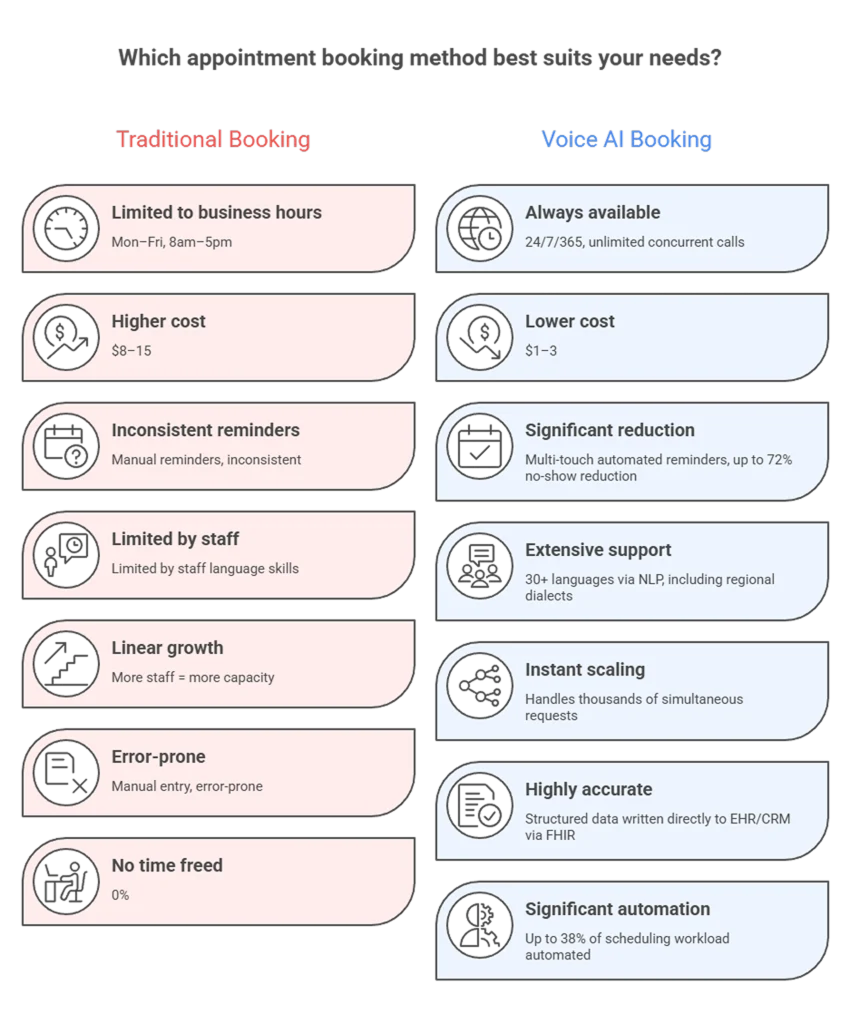
Before evaluating voice assistants, it helps to understand exactly what they replace. The table below compares traditional phone-and-form scheduling against AI-powered voice booking across the dimensions that matter most to hospital operations teams.
Availability. Traditional booking is limited to business hours and staff capacity. Voice assistants operate 24/7, handling simultaneous requests without hold times.
Cost per booking. Manual scheduling typically costs $8–15 per appointment when factoring in staff time, phone infrastructure, and error correction. AI voice agent healthcare reduces this to $1–3 per booking by automating the entire workflow.
No-show management. Phone-based reminders are inconsistent and resource-intensive. Voice assistants deliver multi-touch, personalised reminders at optimal intervals (72 hours and 24 hours before the appointment), with one-tap confirm or reschedule options, cutting no-show rates by up to 72%.
Language support. Traditional call centres require multilingual staff, which is expensive and hard to scale. Voice assistants handle dozens of languages natively using NLP models, making healthcare access equitable across diverse patient populations.
Scalability. Adding call centre capacity means hiring, training, and managing more staff. voice AI healthcare appointment scheduling scales instantly during peak demand (flu season, vaccination drives, outbreaks) without additional headcount.
Data capture. Manual booking often results in incomplete or inaccurate patient records. Voice assistants capture structured data (patient ID, appointment type, preferred provider, insurance details) and write it directly to the EHR and scheduling system in real time.
How Do Voice Assistants Work for Healthcare Scheduling?
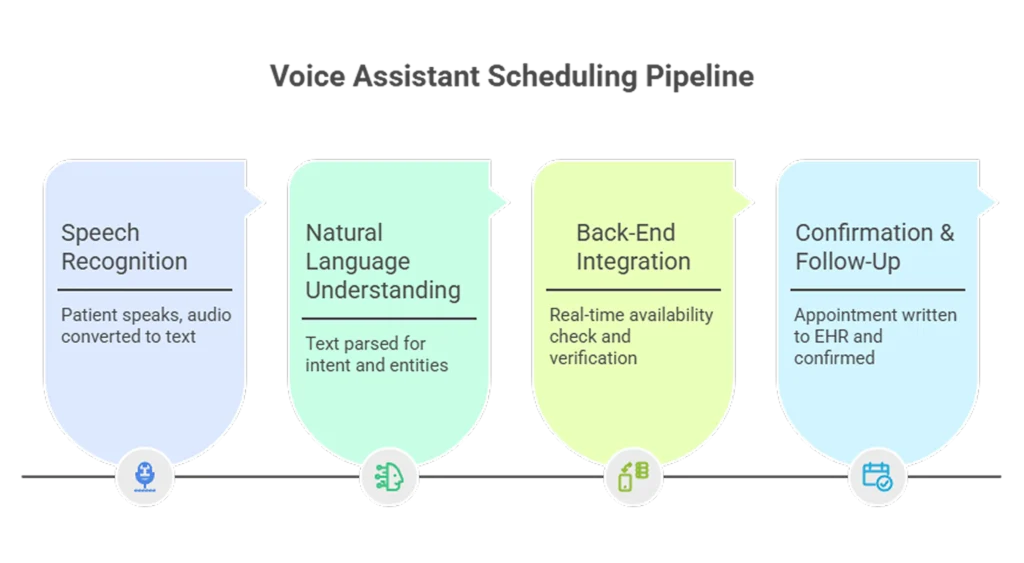
A voice assistant for healthcare scheduling operates through a four-stage pipeline that converts spoken patient input into a confirmed appointment record inside the hospital’s systems.
Stage 1: Speech Recognition. The patient speaks naturally (“I need to see Dr. Patel next Thursday afternoon”). Automatic speech recognition (ASR) converts the audio to text. Modern ASR models handle accents, medical terminology, and background noise with accuracy rates above 95%.
Stage 2: Natural Language Understanding (NLU). The NLU engine extracts intent (book, reschedule, cancel) and entities (provider name, date, time preference, appointment type). It disambiguates: “next Thursday” becomes a specific calendar date; “afternoon” maps to available slots between 12:00 and 17:00.
Stage 3: Back-End Integration. The system queries the scheduling engine via FHIR APIs to check real-time provider availability, patient eligibility, and insurance coverage. If the requested slot is unavailable, the assistant proposes alternatives ranked by proximity to the patient’s preference.
Stage 4: Confirmation and Follow-Up. The assistant confirms the booking, writes the appointment to the EHR, and triggers a confirmation message through the patient’s preferred channel (voice callback, SMS, WhatsApp, email). Automated reminder sequences are scheduled (72h + 24h) with one-tap reschedule links.
Technical Integration: Connecting the Voice agent healthcare to Hospital Systems
For hospital administrators and Health IT professionals, the most significant advantage of voice assistants is their ability to integrate securely and effectively with back-end infrastructure. Successful implementations typically include EHR and scheduling system integration to enable real-time availability checks and booking updates, Natural Language Understanding (NLU) capabilities to support multilingual patient interaction, omni-channel deployment via smart devices, mobile apps, and IVR phone systems, and FHIR-compatible APIs for standardised data exchange.
Voice assistants use FHIR (Fast Healthcare Interoperability Resources) APIs to securely exchange standardised healthcare data. These APIs enable voice systems to access appointment slots, patient records, and provider availability through consistent formats, reducing integration time by 30–40% compared to custom approaches.
When voice scheduling is connected to an AI hospital CRM, the booking data feeds directly into patient engagement workflows: automated pre-visit prep, post-visit follow-ups, and feedback collection all trigger from the same appointment event.
HIPAA compliance is non-negotiable. Voice data must be encrypted during transmission and at rest. Patient identity verification (date of birth, MRN, or biometric voice print) must precede any access to Protected Health Information. Audit logs must record every interaction. Leading implementations use end-to-end encryption and store voice recordings only when explicit patient consent is captured.
Real-World Results: How Leading Hospitals Use Voice Assistants
United States
Leading healthcare systems including Kaiser Permanente, Cleveland Clinic, Providence Health, and Mass General Brigham have implemented voice assistants for scheduling. Key technology providers include Microsoft Healthcare Bot, Google Health AI, and Amazon Comprehend Medical. Northeast Medical Group implemented a voice-first scheduling system and experienced significant improvements in booking completion rates and staff time savings.
Healthcare organisations like Cleveland Clinic and Mayo Clinic are now leveraging advanced voice capabilities to not only schedule appointments but also help prioritise urgent cases and suggest appropriate care levels based on symptom description.
In India, the combination of voice assistants and WhatsApp patient communication offers massive reach, especially in semi-urban and rural areas where voice-first interaction is the natural digital entry point, showing how AI WhatsApp bots are changing patient access by making support available through familiar everyday channels.
India
Apollo Hospitals deployed an Alexa-based voice skill linked to its internal scheduling systems. Later enhanced with multilingual support through WhatsApp and mobile platforms, Apollo reported a 49% increase in appointment bookings, particularly from regions with limited digital literacy. Their latest update added support for 8 regional languages, allowing them to reach over 80% of the Indian population in their native language.
In India, the combination of voice assistants and WhatsApp patient communication offers massive reach, especially in semi-urban and rural areas where voice-first interaction is the natural digital entry point.
Middle East
Medcare Hospitals in the UAE launched an AI assistant capable of handling bookings, cancellations, and rescheduling in real time. With Arabic-English bilingual capabilities and backend system integration, the assistant significantly improved both patient satisfaction and staff productivity. The UAE Ministry of Health has since established new standards for voice assistant implementation, making it part of their 2025 healthcare digitisation initiative.
These regional case studies share a common success factor: seamless integration with existing hospital systems (scheduling engines, CRMs, EHRs) combined with the ability to deliver a responsive, voice-enabled interface localised for the patient population.
How Do Voice Assistants Reduce No-Show Rates?
No-shows are one of healthcare’s most expensive blind spots. In the US alone, missed appointments are estimated to cost providers more than $150 billion annually. Voice assistants attack no-shows through three mechanisms.
Multi-touch, personalised reminders. Unlike generic SMS blasts, voice assistants deliver conversational reminders at optimal intervals. They call the patient, confirm intent, and offer one-tap rescheduling if the patient cannot make it. The conversational format drives higher engagement than text-only reminders.
Predictive no-show identification. AI models analyse historical attendance patterns, demographic factors, and appointment characteristics to flag high-risk patients. These patients receive enhanced engagement: additional reminder touchpoints, transportation assistance information, and proactive outreach from staff.
Instant waitlist backfill. When a patient cancels or reschedules, the voice assistant immediately contacts waitlisted patients with matching availability preferences and books the open slot in real time. This preserves clinic capacity that would otherwise be lost.
The Future of Voice Assistants in Healthcare Scheduling
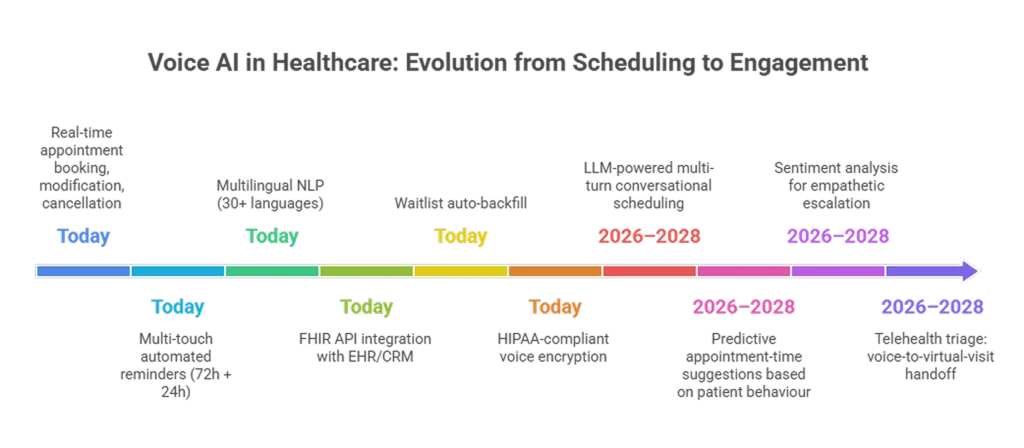
The latest voice assistants are transcending basic scheduling functionality and are closely tied to the future of telemedicine key trends, where intelligent, always-available virtual front doors become a standard part of care delivery.
Large Language Models (LLMs) that enable more natural, context-aware conversations with patients. Instead of rigid slot-filling dialogues, the assistant can handle complex multi-turn requests (“I need to see my cardiologist sometime next week, but not Tuesday, and I’d prefer morning”) in a single conversational flow.
Predictive analytics that suggest optimal appointment times based on historical data and patient preferences. Systems at MetroHealth and Johns Hopkins are already using this to reduce scheduling friction.
Sentiment analysis that detects patient stress or confusion and adjusts responses accordingly, slowing down, simplifying language, or escalating to a human agent.
Integration with telehealth platforms for seamless virtual care transitions is accelerating. Learn more about Quad One’s AI telemedicine solution and how voice-booked appointments can transition between in-person and virtual modalities based on clinical need.
The next generation of voice solutions will not only streamline bookings but also support triage, medication adherence, and chronic disease management, turning the scheduling touchpoint into a broader patient engagement channel.
Implementation Playbook: Getting Started with Voice Scheduling
For hospital executives, innovation leaders, and health IT professionals looking to implement voice assistants, the following action steps provide a structured path to deployment:
Step 1: Audit current scheduling inefficiencies. Quantify call volumes, average hold times, no-show rates, cost-per-booking, and staff time spent on scheduling. This establishes the baseline for ROI measurement.
Step 2: Define integration requirements. Map the voice assistant’s data needs: which EHR fields, scheduling engine APIs, and patient identity verification methods are required. Confirm FHIR API availability from your EHR vendor.
Step 3: Start with a single high-volume use case. New patient appointments or follow-up scheduling are ideal pilots. Limit scope to one department or clinic to prove value before expanding.
Step 4: Configure multilingual and omni-channel support. Prioritise the languages spoken by your patient population. Deploy across the channels patients already use: phone (IVR), mobile app, smart speakers, and WhatsApp.
Step 5: Measure and iterate. Track booking completion rate, no-show rate delta, cost-per-booking reduction, and patient satisfaction scores. Use A/B testing for reminder timing, channel, and conversational style.
Conclusion
Voice assistants in healthcare do not just enhance operational efficiency. They play a vital role in advancing patient-centric care by removing friction from the first touchpoint most patients have with a hospital: booking an appointment. By automating and personalising the scheduling process, they help healthcare providers reduce administrative burden, cut no-show rates, lower cost-per-booking, and free clinical and front-desk staff to focus on higher-value interactions.
The integration of voice assistants with EHR, CRM, and telehealth platforms means the scheduling interaction becomes the starting point for a connected patient journey, not an isolated transaction.
As these systems evolve alongside conversational tools, hospitals can also leverage how chatbots improve patient engagement by extending the same intelligent, automated experience beyond booking into reminders, education, and ongoing follow-up.
Book a demo to see how Quad One’s AI-powered voice and scheduling solutions connect appointment booking, patient engagement, and clinical workflows in one platform.
Patient engagement has become a strategic priority for hospitals and healthcare providers in the digital-first healthcare ecosystem. With the growing expectations for real-time communication, personalized care, and seamless access to services, healthcare organizations are leveraging advanced technologies to bridge communication gaps. Among these innovations, the AI WhatsApp Chatbot for Healthcare, powered by Natural Language Processing (NLP), is revolutionizing how hospitals interact with patients, providing 24/7 support and enhancing patient-centric care.
What is an AI WhatsApp Chatbot for Healthcare?
An AI WhatsApp Chatbot for Healthcare is an intelligent virtual assistant integrated within the WhatsApp platform, specifically designed to automate and personalize communication between healthcare providers and patients. Powered by AI and NLP technologies, these chatbots facilitate human-like conversations, enabling hospitals to offer real-time assistance, appointment booking, medication reminders, and health information dissemination through an accessible messaging platform.
Role of NLP in Chatbot Communication
Natural Language Processing (NLP) enables chatbots to understand patient queries in multiple languages, interpret context, and provide accurate responses. NLP in Chatbot systems is crucial in healthcare, where patients may use non-technical language or regional dialects to communicate their concerns.
Benefits of AI WhatsApp Chatbots in Enhancing Patient Engagement
Real-Time Patient Communication
With instant communication capabilities, AI WhatsApp Chatbots ensure that patients receive timely responses to their queries without waiting for human intervention. Whether it’s scheduling an appointment, getting lab results, or accessing post-discharge instructions, the chatbot operates 24/7, significantly improving patient satisfaction.
Personalized Patient Experience
AI WhatsApp Chatbots use Hospital CRM systems to access patient history, preferences, and previous interactions. This data-driven healthcare approach allows the chatbot to deliver personalized health tips, medication schedules, and preventive care reminders, enhancing the overall patient experience.
Automation for Operational Efficiency
Automating repetitive administrative tasks through AI chatbots reduces the burden on hospital staff, enabling them to focus on clinical care. Functions like appointment management, feedback collection, and FAQs can be fully automated, leading to operational efficiency and cost savings.
Automation for Operational Efficiency
24/7 Availability for Patients
AI WhatsApp Chatbots provide round-the-clock support, making healthcare services accessible anytime, especially beneficial for emergency queries or remote patients in different time zones.
Scalability and Cost-Effectiveness
Hospitals can easily scale their chatbot operations without increasing human resource costs. A single chatbot can handle thousands of patient queries simultaneously, reducing dependency on call centers.
Consistent Patient Communication
AI chatbots ensure that all patients receive uniform and accurate information, reducing the risk of misinformation and maintaining healthcare service quality standards.
Improved Patient Education
Chatbots can be programmed to share educational content about diseases, treatment plans, healthy habits, and preventive care, helping patients stay informed about their health conditions.
Reduced Appointment No-Shows
By sending automated appointment reminders and follow-up messages, chatbots help minimize patient no-shows, ensuring better utilization of healthcare resources.
Real-World Use Cases of AI WhatsApp Chatbots in Healthcare
Chronic Disease Management
Hospitals are deploying AI WhatsApp Chatbots to support chronic disease management programs by sending automated medication reminders, lifestyle modification tips, and follow-up appointment alerts, promoting better patient compliance.
COVID-19 Information Dissemination
During the pandemic, AI in healthcare saw increased adoption of WhatsApp chatbots for disseminating critical information related to testing centers, vaccination appointments, and COVID-19 guidelines, ensuring accurate information reached patients instantly.
Mental Health Support
Some healthcare providers have integrated NLP in Chatbots to offer emotional support and preliminary mental health assessments, ensuring patients have a confidential platform for expressing their concerns before consulting a professional.
Key Features that Set AI WhatsApp Chatbots Apart
Predictive Analytics for Proactive Care
Using Hospital CRM data, AI chatbots can identify high-risk patients and provide them with proactive care suggestions, improving preventive care strategies.
Multilingual Support
NLP-driven chatbots can engage patients in their preferred language, breaking communication barriers in multilingual regions.
Integration with Hospital CRM
The seamless integration of AI WhatsApp Chatbots with existing Hospital CRM systems ensures that all patient interactions are captured, analyzed, and utilized for continuous improvement in care delivery.
Challenges in Implementing AI WhatsApp Chatbots
Data Privacy and Security
Patient data confidentiality is a top concern. Healthcare providers must ensure that AI chatbots comply with data protection regulations such as HIPAA and GDPR, implementing end-to-end encryption and secure data storage practices.
Maintaining Accuracy in NLP Responses
AI Chatbots require continuous learning and updates to handle new medical terminologies, patient behaviors, and healthcare scenarios effectively. Regular training and monitoring are essential to maintain accuracy and relevance.
The Future of AI WhatsApp Chatbots in Healthcare
The future of AI WhatsApp Chatbots is promising, with advancements expected in AI-driven virtual health assistants, telemedicine integrations, wearable device connectivity, and predictive patient engagement models. These technologies will further enhance the role of chatbots in delivering personalized, accessible, and efficient patient care.
Key Takeaways
AI WhatsApp Chatbots for Healthcare, powered by NLP, are transforming patient engagement by enabling real-time communication, personalized care, and operational efficiency. As healthcare providers continue to embrace digital transformation, these chatbots will play a vital role in improving patient-centric care delivery.
Experience Smarter Patient Engagement with AI
Subscribe to get expert insights, use cases, and practical tips on how AI WhatsApp Chatbots are reshaping healthcare communication and patient care. and want to know how the implementation works, read this blog: Healthcare WhatsApp chatbot implementation
| Quick Answer: AI chatbots improve patient engagement in healthcare by providing 24/7 automated support across triage, appointment scheduling, medication reminders, and post-discharge follow-up. Unlike rule-based bots, AI-powered chatbots use natural language processing to understand context, personalise responses, and integrate with EHR systems — reducing administrative burden while improving patient satisfaction and care continuity. |
AI chatbots in healthcare are no longer futuristic. They are a present-day reality reshaping how patients engage with care providers. Unlike basic rule-based bots that follow pre-programmed scripts, AI-powered chatbots can understand context, respond dynamically, and learn over time to improve interactions. These chatbots are embedded in websites, mobile apps, EHR systems, and messaging platforms, and their core purpose is to assist patients with routine tasks and information without the need for live human intervention.
From real-time support and multilingual communication to personalized follow-ups and streamlined scheduling, these digital assistants are helping hospitals and health systems meet rising patient expectations while easing the load on clinical staff. Systems like UCHealth, Mount Sinai Health System, and Singapore General Hospital are already running live deployments that demonstrate measurable impact.
Chatbots on messaging platforms like WhatsApp extend this reach further. Quad One’s AI WhatsApp Bot lets patients schedule appointments, retrieve reports, and get support in their own language all within a single WhatsApp conversation, with no app downloads required, illustrating how AI WhatsApp bots are changing patient access by removing friction from the first point of contact.
What Is the Difference Between a Rule-Based and AI-Powered Healthcare Chatbot?
Not all healthcare chatbots are created equal. Understanding the distinction between rule-based and AI-powered chatbots is critical for healthcare leaders evaluating solutions.
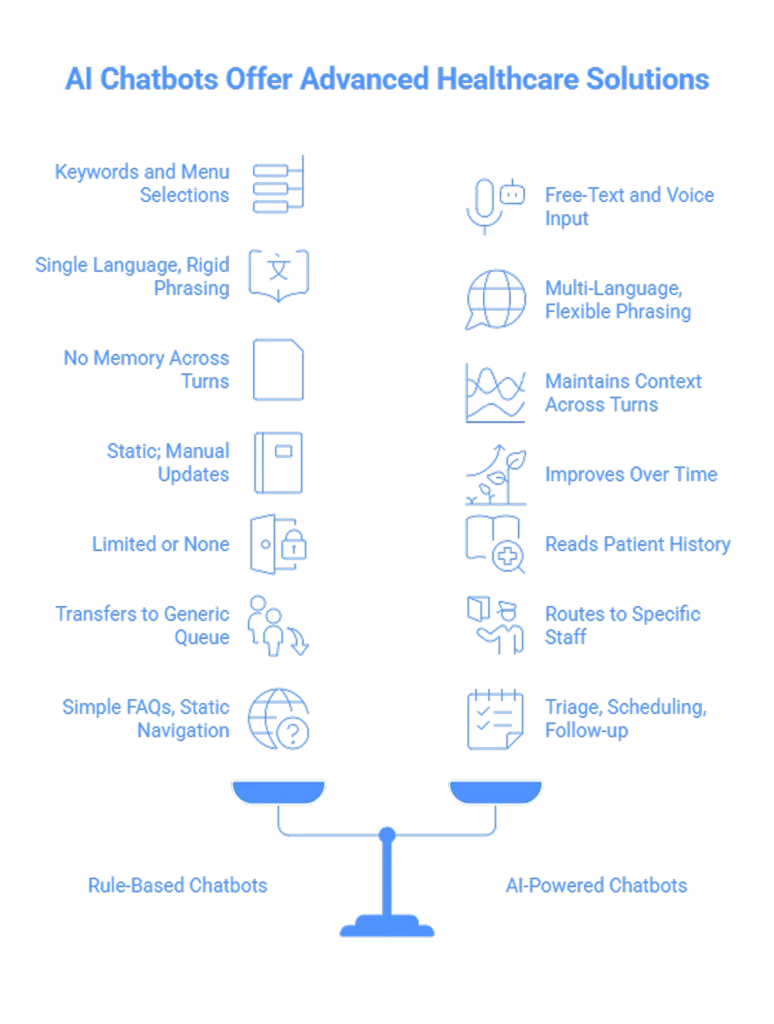
Rule-based chatbots follow pre-programmed decision trees. They respond to specific keywords or menu selections with fixed answers. They work well for simple, predictable tasks (FAQs, basic navigation) but break down when patients phrase questions in unexpected ways. They cannot learn, cannot handle ambiguity, and cannot maintain context across a multi-turn conversation.
AI-powered chatbots use natural language processing (NLP) and machine learning to understand intent, extract entities, and generate contextual responses. They handle free-text input, support multiple languages, improve over time as they process more interactions, and can escalate to human staff when they detect clinical complexity or patient distress. Modern AI chatbots can also integrate with EHR and CRM systems to personalise responses based on a patient’s history.
The practical difference: a rule-based bot might fail if a patient types “I need to see someone about my knee” instead of selecting “Orthopedics” from a menu. An AI chatbot understands the intent, maps it to the right department, checks provider availability, and offers to book.
How Do AI Chatbots Improve Patient Engagement? Core Use Cases
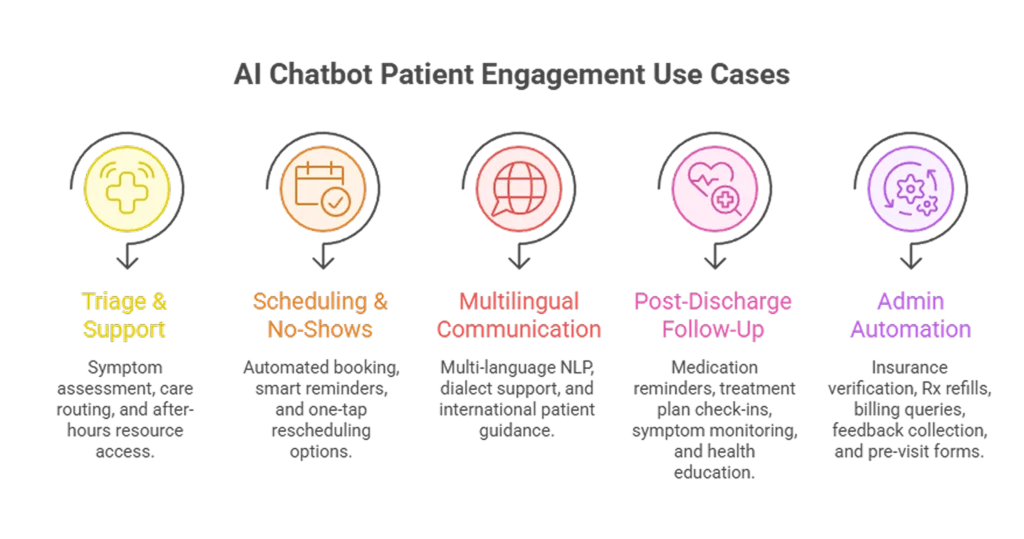
1. 24/7 Instant Support and Triage
One of the most immediate advantages of AI chatbots is their ability to provide instant, around-the-clock assistance. Patients do not have to wait for business hours or navigate phone trees. A chatbot can answer questions about symptoms, medications, billing, insurance, or hospital services at any hour. For clinical queries, AI chatbots can perform preliminary triage, assessing symptom severity and routing patients to the appropriate care level (self-care guidance, GP appointment, urgent care, or emergency).
Mount Sinai Health System deployed an AI chatbot that handles basic triage questions and connects patients to relevant resources after hours. This reduces the burden on call centres and builds patient trust by ensuring help is always available.
2. Appointment Scheduling and No-Show Reduction
AI chatbots automate appointment bookings, send smart reminders, and help reschedule when needed. UCHealth in Colorado uses a chatbot named Livi, which integrates with their My Health Connection patient portal to streamline the booking process and reduce no-show rates. Livi helps patients schedule appointments, check symptoms, and access educational resources, handling thousands of interactions per month.
3. Multilingual Patient Communication
In regions with linguistic diversity, language is a barrier to effective healthcare. AI chatbots support multiple languages and dialects, making information accessible to a wider audience. Bumrungrad International Hospital in Thailand uses AI chatbots that offer multilingual support for international patients, guiding them through registration, pre-consultation FAQs, and post-visit summaries. This level of inclusivity ensures no patient is left behind due to language limitations.
4. Post-Discharge Follow-Up and Education
Engaging patients does not end when they leave the clinic. AI chatbots can follow up on treatment plans, send personalised medication reminders, and check on symptoms. These ongoing interactions also serve as a powerful tool for education, delivering easy-to-understand information that empowers patients to take charge of their health. Singapore General Hospital employs AI chatbots in its telehealth services to screen symptoms and route patients to appropriate departments before consultations, improving response time and reducing clinical staff workload.
5. Administrative Automation
Beyond patient-facing interactions, chatbots automate high-volume administrative tasks: insurance verification, prescription refill requests, billing queries, feedback collection, and pre-visit form completion. Each of these tasks, when handled manually, consumes staff time and introduces error risk. A single AI chatbot can handle thousands of these interactions simultaneously, freeing clinical and front-desk staff for higher-value work.
Real-World Case Studies: UCHealth, Mount Sinai, and Singapore General Hospital
UCHealth (Colorado, USA)
UCHealth implemented Livi, an AI chatbot integrated with its My Health Connection portal. Originally built to help patients find locations and providers, Livi quickly evolved as patients began asking about test results, doctor messages, and health-specific questions. The chatbot now handles thousands of interactions per month, improving patient access to information and reducing administrative overhead for staff. Livi bridges the gap between patients and their digital health tools, helping them accomplish tasks faster using systems that already exist.
When chatbot interactions feed into an AI hospital CRM, every patient query becomes actionable data: appointment requests route to scheduling, symptom reports trigger care workflows, and satisfaction signals inform service recovery.
Mount Sinai Health System (New York, USA)
Mount Sinai launched a chatbot capable of answering general medical questions, guiding users to care pathways, and connecting them to telemedicine options during non-clinical hours. The chatbot handles basic triage questions and routes patients to the right resources, reducing the burden on after-hours call centres and building patient trust through always-available support.
Singapore General Hospital
Singapore General Hospital employs AI chatbots in its telehealth services to screen symptoms and route patients to appropriate departments before consultations. This method helps prioritise care needs, reduce wait times, and ensure patients are well-prepared before meeting a provider either virtually or in person. The integration of triage chatbots with telehealth has been particularly effective in managing specialist referral workflows.
These case studies share a common pattern: AI chatbots succeed when they are integrated with existing clinical systems (EHR, scheduling engines, patient portals) and when they are designed to escalate to human staff at the right moment, not replace them.
How AI Healthcare Chatbots Work: Technical Architecture
A healthcare AI chatbot operates through a pipeline that converts patient input into an actionable response:
Natural Language Processing (NLP) parses the patient’s input (text or voice-to-text), identifies intent (book, ask, cancel, report symptom), and extracts entities (provider name, date, symptom type, medication name).
Dialogue management maintains conversation context across multiple turns. If a patient asks about a test result and then says “what does that mean?”, the system understands “that” refers to the previously discussed result, not a new query.
Back-end integration connects via APIs (including FHIR where applicable) to EHR systems, scheduling engines, billing platforms, and knowledge bases. The chatbot reads real-time data (appointment availability, lab results, insurance status) and writes actions back (book appointment, create refill request, log triage outcome).
Safety and escalation logic ensure the chatbot knows its limits. When it detects clinical urgency (chest pain, suicidal ideation), ambiguity it cannot resolve, or patient frustration, it transfers to a human agent with the full conversation context attached. No cold handoff.
HIPAA compliance requires end-to-end encryption, patient identity verification before PHI access, audit logging of every interaction, and secure data storage. The chatbot vendor must sign a Business Associate Agreement (BAA).
The Future of AI Chatbots in Patient Engagement
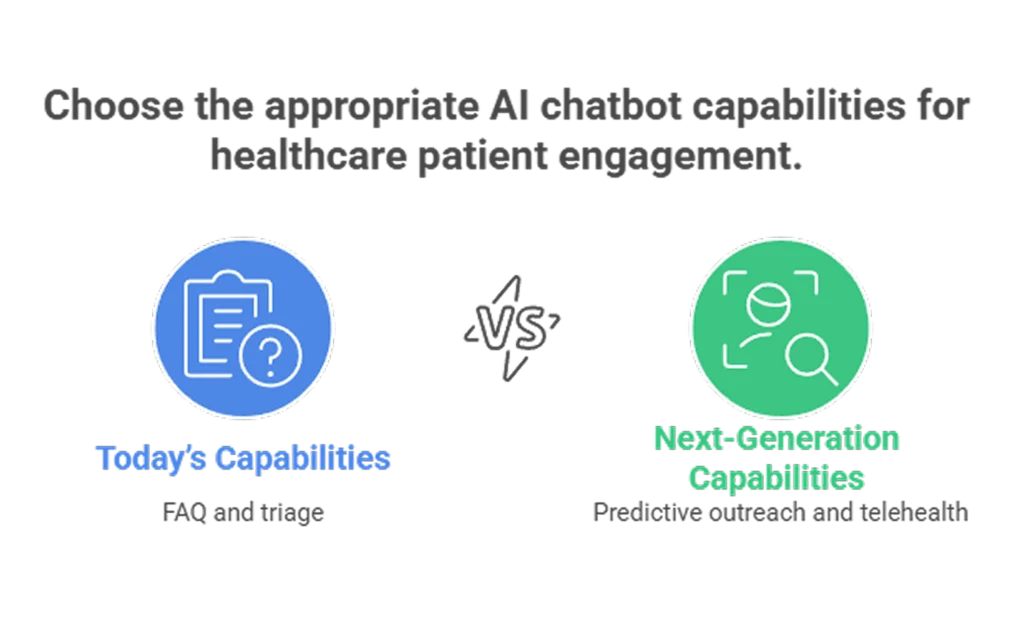
As technology continues to evolve, AI chatbots will become more predictive, more integrated, and more essential to delivering high-quality, patient-centred care. Key developments on the horizon include:
Predictive engagement. Chatbots that proactively reach out to patients based on risk signals (overdue screenings, medication non-adherence patterns, post-surgical recovery milestones) rather than waiting for patients to initiate contact.
Deeper EHR integration. Chatbots that access real-time clinical data to offer personalised, context-aware responses. A patient asking “When is my next appointment?” gets a specific answer, not a generic “Please call our office.”
Telehealth convergence. Chatbots that triage symptoms and smoothly hand off to a live video consultation when clinical assessment is needed. Explore Quad One’s AI telemedicine solution to see how chat-to-video workflows are already operational.
Ambient listening and documentation. AI chatbots that listen to patient-provider conversations (with consent), generate structured clinical notes, and push them to the EHR, reducing documentation burden on clinicians.
Emotional intelligence. Sentiment analysis that detects patient anxiety, confusion, or frustration and adjusts conversational tone, pace, and complexity in real time.
Conclusion
AI chatbots in healthcare are not a single-use tool. They are a versatile patient engagement layer that operates across the full care continuum: from pre-visit triage and scheduling through in-visit support to post-discharge follow-up and chronic disease management. What makes them powerful is their versatility. They are equally effective in busy US health systems like UCHealth as they are in forward-thinking Asian providers like Singapore General Hospital.
For healthcare leaders looking to enhance engagement, improve operational efficiency, and support patient-centered care, the time to invest in AI chatbot solutions is now.
Explore Quad One’s AI Chatbot Solutions. Book a demo to see how our AI-powered chatbot and WhatsApp bot connect triage, scheduling, follow-up, and patient engagement in one platform.
External References
Chatbots in Health Care
